
Retirement is often viewed as the finish line of a long professional journey. However, for most people, receiving a retirement corpus is not the end of financial planning—it is the beginning of an entirely new challenge.
Suppose you retire with ₹50 lakh in savings. At first glance, the amount may appear sufficient to provide financial security. But the real question is not how much money you have today. The real question is whether that money can support your lifestyle for the next 20 to 30 years without running out.
This is where retirement investing becomes crucial.
Many retirees make the mistake of placing their entire corpus into fixed deposits or savings accounts. While these options provide safety, they often fail to protect wealth from inflation. On the other hand, investing too aggressively in equities can expose retirees to market volatility at a stage of life when preserving capital is equally important.
The ideal retirement strategy lies somewhere in between—a balanced approach that generates regular income while ensuring long-term growth.
The Three Major Goals of Retirement Investing
Before choosing any investment product, retirees must understand their primary financial objectives.
Regular Monthly Income
Most retirees need a steady income stream to cover daily expenses, utility bills, healthcare costs, and lifestyle needs.
Capital Protection
The retirement corpus often represents decades of hard-earned savings. Protecting that capital becomes a top priority.
Inflation Protection
Even moderate inflation can significantly reduce purchasing power over time. A monthly expense of ₹40,000 today could become ₹70,000 or more in the future.
A successful retirement portfolio should address all three goals simultaneously.
Why Putting Everything in Fixed Deposits Is Not Ideal
Fixed Deposits (FDs) remain one of the most popular investment options among retirees.
The reasons are obvious:
- Predictable returns
- Low risk
- Easy accessibility
- Familiarity
Many banks offer senior citizen FD rates that are higher than regular deposits.
However, relying entirely on FDs has limitations.
The biggest challenge is inflation.
If an FD generates 7% annual returns and inflation averages 5% to 6%, the real growth in purchasing power remains minimal.
Additionally, interest income from FDs is taxable according to the investor’s tax slab, which can further reduce effective returns.
While FDs provide stability, they should not become the sole retirement investment vehicle.
Why SCSS Is Popular Among Retirees
The Senior Citizen Savings Scheme (SCSS) is specifically designed for retirees and senior citizens.
Backed by the Government of India, it is considered one of the safest investment options available.
The scheme currently offers an attractive interest rate and provides quarterly payouts, making it particularly suitable for generating regular income. The interest rate is locked in when the account is opened and remains fixed throughout the tenure.
Key advantages include:
- Government-backed security
- Regular income through quarterly interest payments
- Relatively higher returns compared to many traditional savings options
- Suitable for conservative investors
However, SCSS also has limitations.
The scheme alone may not adequately protect against inflation over long retirement periods. Therefore, financial planners generally recommend using SCSS as a stable income component rather than the entire retirement strategy.
The Role of Mutual Funds in Retirement
Many retirees hesitate when they hear the term “mutual funds.”
The common perception is that mutual funds are risky and suitable only for younger investors.
In reality, not all mutual funds carry the same level of risk.
Certain categories can play an important role in retirement planning.
Debt Mutual Funds
Debt funds invest primarily in fixed-income securities such as bonds and government securities.
Benefits include:
- Better liquidity
- Potential tax efficiency in some cases
- Lower volatility compared to equity funds
- Useful for emergency funds
Hybrid Mutual Funds
Hybrid funds combine equity and debt investments.
They provide:
- Moderate growth potential
- Lower risk than pure equity funds
- Better inflation protection
- Diversification
Equity Mutual Funds
Even retirees may consider limited exposure to equity-oriented funds.
The purpose is not aggressive wealth creation but maintaining purchasing power over decades.
A small allocation to equity can help retirement savings grow faster than inflation.
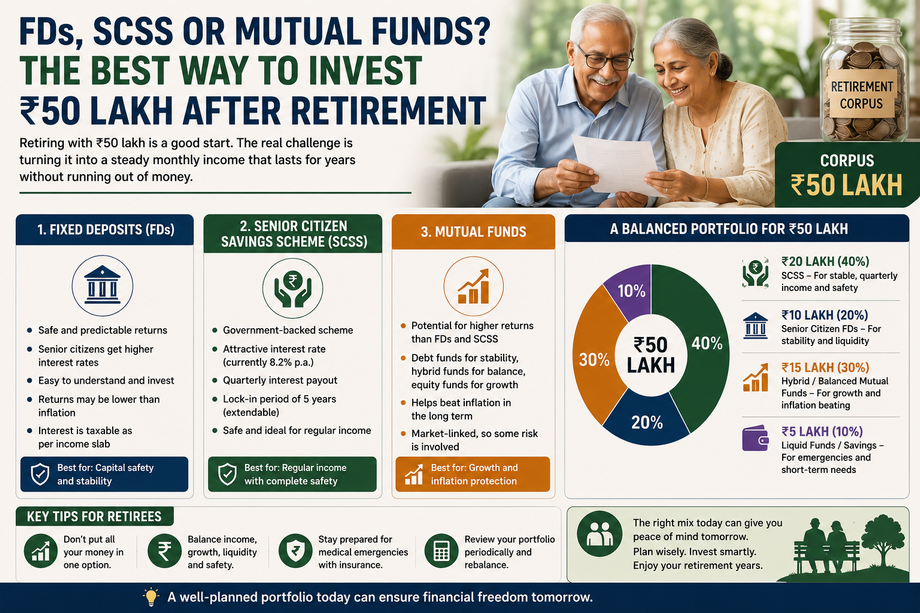
A Practical Allocation Strategy for ₹50 Lakh
Every retiree’s situation is unique. Factors such as age, health, pension income, family responsibilities, and risk tolerance should influence investment decisions.
However, a balanced allocation could look like this:
₹20 Lakh in SCSS
This portion provides predictable quarterly income and strong capital protection.
₹10 Lakh in Senior Citizen FDs
This adds stability and diversification while ensuring easy access to funds.
₹15 Lakh in Hybrid or Balanced Mutual Funds
This component focuses on moderate growth and inflation protection.
₹5 Lakh in Liquid Funds or Savings Instruments
This acts as an emergency reserve for unexpected expenses, especially medical emergencies.
Such a structure balances income, liquidity, safety, and growth.
How Much Monthly Income Can ₹50 Lakh Generate?
The answer depends on the investment mix and prevailing interest rates.A retirement portfolio combining SCSS, FDs, and mutual funds can potentially generate a regular income stream while preserving a portion of the corpus for future growth.
However, retirees should avoid focusing solely on immediate income.With life expectancy increasing, retirement savings may need to last 25 years or longer. Therefore, preserving purchasing power becomes equally important.A portfolio that generates income today but fails to grow may struggle to support future expenses.
Common Mistakes Retirees Should Avoid
Investing Everything in One Product
Concentration risk can create unnecessary problems.
Diversification remains important even after retirement.Ignoring InflationMany retirees focus exclusively on safety while overlooking the gradual impact of rising costs.
Keeping Too Much Money Idle
Large balances sitting in savings accounts often earn very low returns.Taking Excessive Market Risk
Some retirees attempt to compensate for low interest rates by investing heavily in high-risk assets.This can expose them to significant losses.
Not Maintaining Emergency Funds
Unexpected medical expenses are among the biggest financial risks during retirement.
A separate emergency reserve is essential.
Healthcare Should Be Part of the Plan
One of the largest retirement expenses is healthcare.
Medical inflation often rises faster than general inflation.
Even retirees with substantial savings can face financial stress if major health issues arise.
Therefore, maintaining adequate health insurance and emergency reserves should be considered a fundamental part of retirement planning.
Investment returns alone cannot replace proper healthcare preparedness.
Why a Combination Approach Works Best
The debate between FDs, SCSS, and mutual funds often assumes that retirees must choose one option.
In reality, the most successful retirement strategies rarely depend on a single product.
Each investment serves a different purpose:
- SCSS provides stable income.
- FDs offer safety and predictability.
- Mutual funds support long-term growth.
- Liquid funds provide flexibility and emergency access.
When combined intelligently, these instruments create a portfolio that addresses multiple retirement needs simultaneously.
Conclusion
Retiring with ₹50 lakh is a significant achievement, but managing that money wisely is even more important than accumulating it.
No single investment option can perfectly meet every retirement objective. Fixed deposits offer safety but limited growth. SCSS delivers reliable income but may not fully beat inflation. Mutual funds provide growth potential but require careful allocation and risk management.
For most retirees, the ideal solution is a diversified portfolio that combines all three. By balancing income generation, capital preservation, liquidity, and inflation protection, retirees can transform a ₹50 lakh corpus into a sustainable financial foundation for the years ahead.
The goal of retirement investing is not simply to earn returns. It is to create financial confidence, maintain independence, and ensure that savings continue supporting a comfortable lifestyle throughout retirement.
