
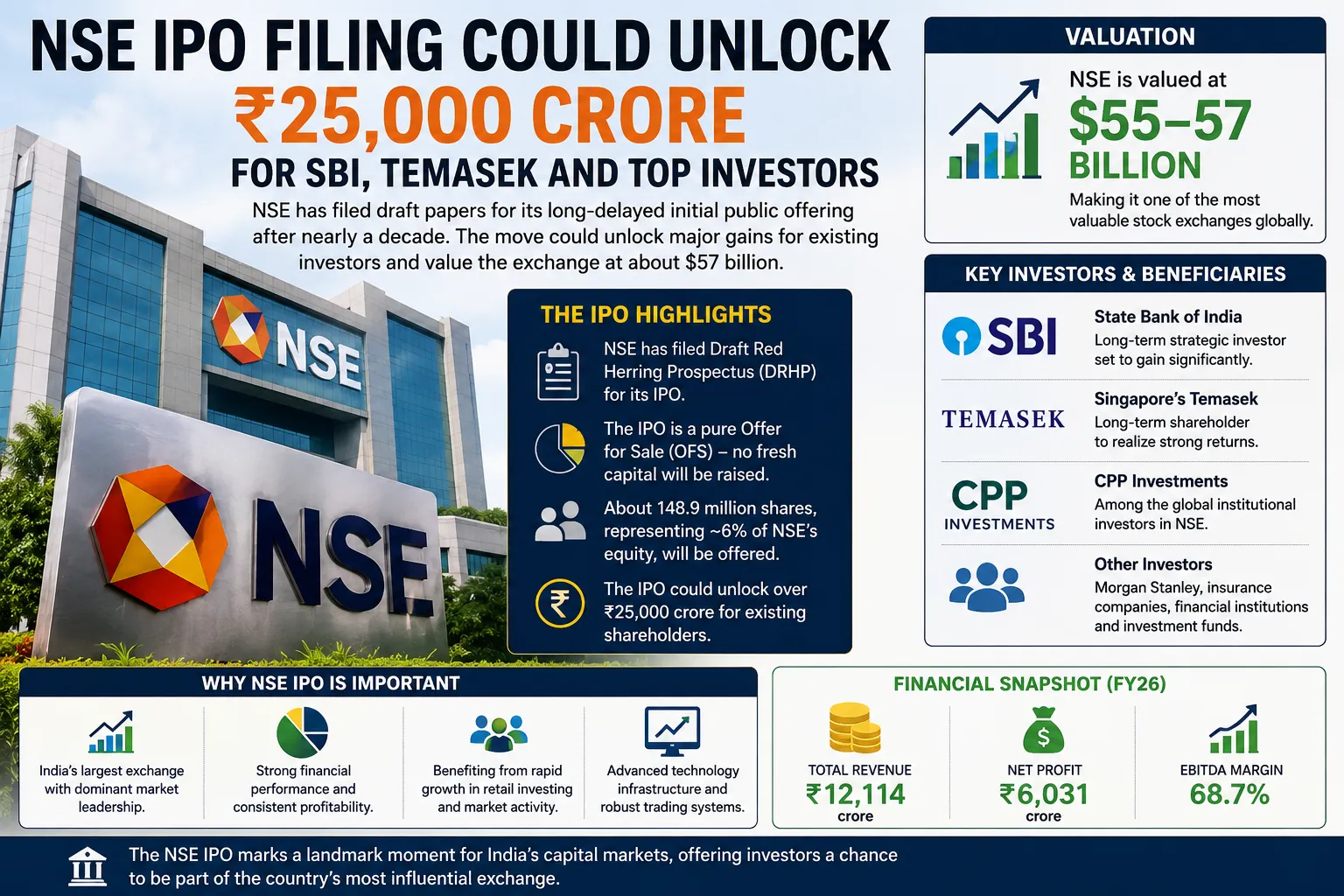
The National Stock Exchange of India (NSE), the country’s leading stock exchange, has filed its draft red herring prospectus (DRHP) with the Securities and Exchange Board of India (SEBI), marking a significant step toward its initial public offering after nearly a decade of delays. This pure offer-for-sale (OFS) IPO, expected to be valued at around $57 billion (approximately ₹5 lakh crore) based on unlisted market trades, could unlock substantial value for existing shareholders, including major institutions like State Bank of India (SBI), Temasek Holdings, and others. Estimates suggest the issue size could be in the range of ₹25,000–30,000 crore, potentially making it one of India’s largest IPOs.
The Journey to IPO: Overcoming Regulatory and Governance Hurdles
NSE’s path to listing has been protracted. The exchange first attempted an IPO around 2016, but regulatory scrutiny and governance issues derailed the process. Central to these challenges were allegations surrounding former Managing Director and CEO Chitra Ramkrishna, including concerns over the co-location scam and other governance lapses that drew investigations from SEBI and other authorities. These issues, combined with broader regulatory requirements for market infrastructure institutions, kept NSE in unlisted territory for years despite its dominant market position.
Recent resolutions, including settlement offers with SEBI, have cleared the way. In 2025, NSE made significant strides by settling disputes, paving the path for the DRHP filing on June 17-18, 2026. The IPO is entirely an OFS of up to approximately 148.9 million shares (about 6% of equity), with no fresh issue component. This structure means all proceeds will go to selling shareholders, providing an exit opportunity while allowing the exchange to maintain operational focus.
Key selling shareholders include SBI as the largest, offering up to 24.75 million shares. Other notable participants are Morgan Stanley’s MS Strategic (Mauritius) Ltd (up to 16 million shares), Canada Pension Plan Investment Board (CPPIB, up to 11.87 million shares), and Temasek affiliates. LIC, the single largest shareholder with around 10.72% stake, is not selling in this round. The offering involves a broad base of NSE’s roughly 190,000-200,000 shareholders, many of whom will have the option to participate.
Massive Value Unlocking for Investors
The IPO represents a historic wealth creation event. For early investors, returns are extraordinary. SBI, which acquired stakes between 1993 and 1999 at an average cost of about 80 paise per share, stands to realize significant gains on its selling portion. At unlisted gray market prices around ₹2,000–2,055 per share, the bank could unlock around ₹5,000 crore ($529 million) from the shares being sold, representing thousands-fold returns.
Temasek Holdings, which acquired a stake (formerly from NYSE Euronext) around 2010 for over ₹780 crore, is poised for approximately 33-fold gains on its selling portion. Morgan Stanley affiliates are expected to see around 31-fold returns. These outcomes far outpace the broader market benchmarks like the Nifty 50 over the same periods, underscoring NSE’s role as a high-conviction investment in India’s financial infrastructure.
Overall, the transaction could unlock tens of thousands of crores for promoters and investors, with SBI, Temasek, and top institutional holders as primary beneficiaries. The unlisted valuation of around $55–58 billion positions NSE among the world’s most valuable exchanges, comparable to entities like the London Stock Exchange Group.
NSE’s Dominant Market Position and Strong Financials
NSE’s appeal stems from its commanding presence in Indian capital markets. It handles the overwhelming majority of trading volumes, particularly in the derivatives segment, where it maintains near-monopoly status with 93%+ market share in many periods. The exchange leads in equity cash segments as well, offering unmatched liquidity that attracts institutional and retail participants alike. Products like Nifty 50 and Bank Nifty futures and options drive massive turnover, making NSE one of the world’s largest derivatives exchanges by contract volume.
Financial performance has been robust. For FY25, consolidated total income reached ₹19,177 crore, with net profit at approximately ₹11,606–12,188 crore (figures vary slightly across reports but confirm strong growth). This reflects healthy expansion in core operations, data services, and other segments amid rising market participation in India. High profitability margins and return on equity underscore operational efficiency.
India’s growing economy, rising retail investor base, digitalization of trading, and policy support for capital markets provide a strong tailwind. As the preferred venue for derivatives and high-volume trading, NSE is well-positioned to benefit from further market deepening.
Implications for Stakeholders and the Broader Market
For investors, the NSE IPO offers exposure to a high-growth financial infrastructure play with monopoly-like characteristics in key segments. It could set a benchmark for valuation in the sector and boost confidence in Indian market institutions. Retail allocation is expected to be favorable (around 35% in many large IPOs), potentially broadening participation.
The listing will occur on BSE (ironically, NSE’s rival), adding another layer of interest. Post-listing, enhanced transparency and governance standards are anticipated, further strengthening investor trust.
Challenges remain, including final SEBI approvals, pricing dynamics, and market conditions. However, the filing itself signals maturity and resolution of past issues. For the economy, a successful NSE listing could catalyze more institutional capital flows, support vibrant secondary markets, and highlight India’s emergence as a global financial hub.
Looking Ahead: Strategic Significance
This IPO transcends a simple share sale; it represents the maturation of India’s exchange ecosystem. From its founding in the 1990s as a technology-driven alternative to BSE, NSE has transformed Indian trading with dematerialization, electronic systems, and derivatives innovation. Its public listing crowns this journey, potentially delivering liquidity events for long-term backers while positioning the exchange for the next phase of growth—international expansion, new products, and technology upgrades.
As India’s capital markets continue to expand, NSE’s public chapter will likely inspire greater innovation and competition, benefiting millions of investors. The unlocking of value for SBI, Temasek, and others is not just a financial milestone but a testament to patient capital in building critical national infrastructure.
In summary, NSE’s IPO filing heralds a new era. With strong fundamentals, dominant market share, and resolved regulatory overhangs, it stands as a compelling narrative of resilience and opportunity in India’s financial landscape. Market participants will watch closely as the process unfolds, anticipating one of the most consequential listings in recent Indian corporate history.
