
For years, Indian banking customers have faced a familiar problem. A customer visits a bank branch to open a fixed deposit and is persuaded to buy an insurance policy. A senior citizen seeking a safe investment is sold a high-risk market-linked product. A borrower applying for a loan is subtly pressured into purchasing additional financial products that may not be necessary. In many cases, customers later discover that they did not fully understand what they had agreed to purchase.
Such practices, commonly referred to as “mis-selling,” have long been a concern for regulators, consumer rights advocates, and customers alike. While the Reserve Bank of India (RBI) has repeatedly issued warnings and advisories over the years, the persistence of these practices has prompted a much stronger response.
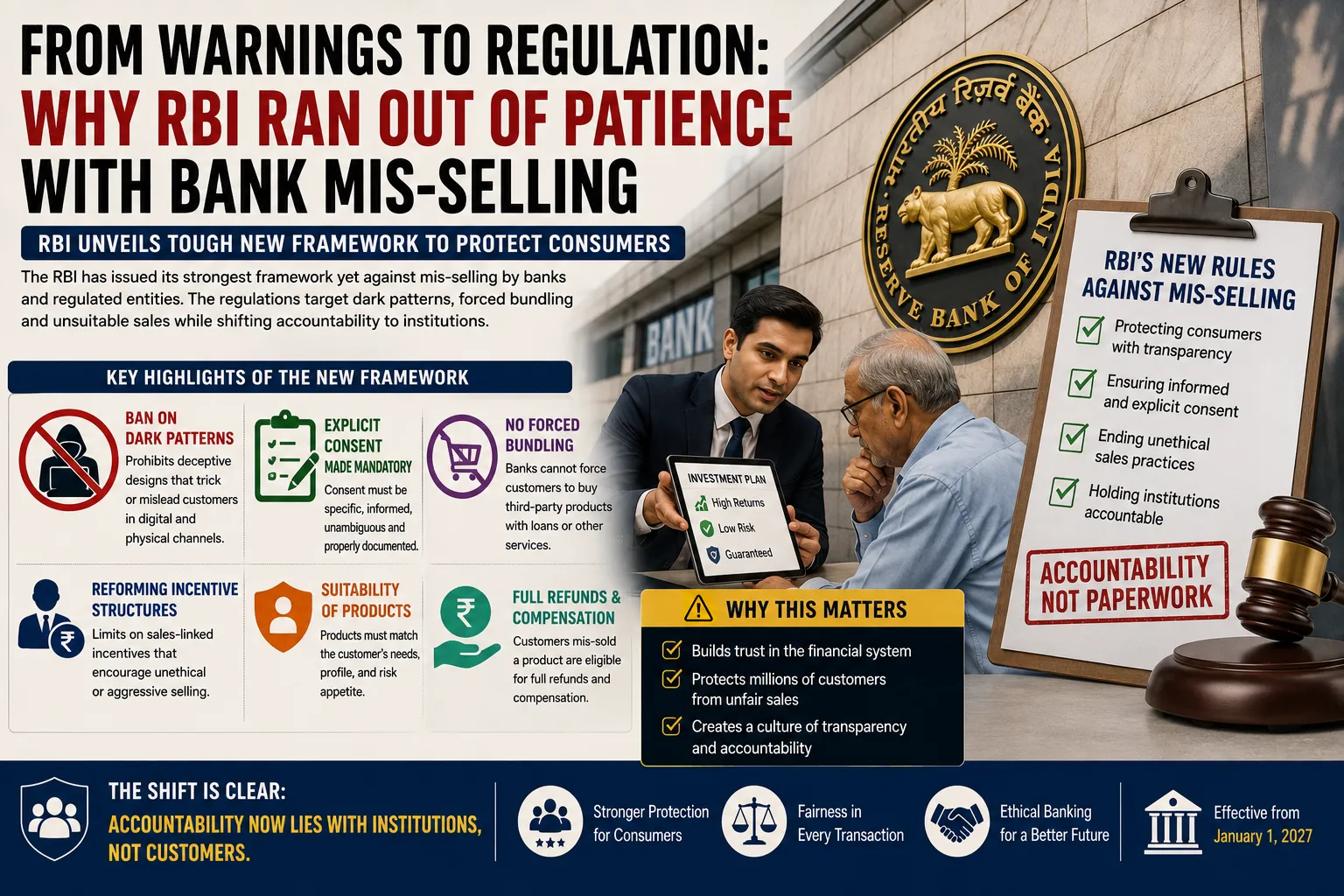
In June 2026, the RBI unveiled one of its most comprehensive frameworks yet to curb mis-selling by banks, non-banking financial companies (NBFCs), and other regulated entities. The new regulations target deceptive sales practices, forced bundling, unsuitable product recommendations, and digital “dark patterns” while placing clear accountability on financial institutions rather than customers. The move signals that the central bank has reached a point where warnings alone are no longer sufficient.
Understanding the Mis-Selling Problem
Mis-selling occurs when a financial product or service is sold in a manner that is misleading, inappropriate, or not suited to a customer’s needs and financial profile.
Common examples include:
- Selling high-risk investment products to conservative investors.
- Bundling insurance policies with loans without proper disclosure.
- Providing incomplete or misleading information about risks and charges.
- Using pressure tactics to influence customer decisions.
- Obtaining consent through confusing or deceptive processes.
The problem has become more complex as financial institutions increasingly distribute third-party products such as insurance policies, mutual funds, pension schemes, and investment products alongside traditional banking services.
For banks, these products generate valuable commission income. However, aggressive sales targets have sometimes created incentives that prioritize revenue generation over customer welfare.
Why RBI Became Concerned
The RBI’s concern stems from the growing evidence that customers were often being persuaded into purchasing products they neither understood nor needed.
Consumer complaints over the years highlighted recurring issues such as:
- Hidden fees and charges.
- Misleading sales presentations.
- Inadequate risk disclosures.
- Forced cross-selling.
- Difficulty cancelling unwanted products.
Particularly vulnerable groups such as senior citizens, first-time investors, rural customers, and individuals with limited financial literacy were often at greater risk.
The RBI increasingly recognized that traditional disclosure requirements alone were not sufficient to protect consumers. Many customers signed documents without fully understanding complex financial products, creating a gap between legal compliance and genuine informed consent.
The Rise of Dark Patterns in Banking
One of the most significant aspects of the new framework is the RBI’s explicit focus on “dark patterns.”
Dark patterns refer to digital design techniques that manipulate users into making decisions they might not otherwise choose. These practices have become increasingly common across websites, apps, and online sales channels.
Examples include:
- Pre-selected checkboxes.
- Hidden charges revealed at the last stage.
- Misleading countdown timers.
- Complicated cancellation processes.
- Interfaces that make rejecting an offer difficult.
In the financial sector, such tactics can influence customers into purchasing products, subscribing to services, or sharing information without fully realizing the consequences.
Recognizing the risks, the RBI has prohibited the use of dark patterns by regulated entities, marking a major step in consumer protection.
The Shift from Customer Responsibility to Institutional Accountability
Perhaps the most important change in the RBI’s new framework is the shift in accountability.
Historically, financial institutions often defended themselves by arguing that customers had signed consent forms and therefore accepted the products voluntarily.
The RBI now takes a different view.
The regulator has made it clear that obtaining a signature alone is not enough. Financial institutions must ensure that products are suitable for the customer and that consent is informed, explicit, and properly recorded.
This represents a significant departure from the traditional “buyer beware” approach. Instead, the responsibility increasingly rests with the seller to ensure ethical conduct.
The message is straightforward: institutions cannot hide behind paperwork if the sales process itself was misleading.
Explicit Consent Becomes Mandatory
Under the new regulations, banks and regulated entities must obtain explicit customer consent before selling financial products.
Consent must be:
- Specific.
- Informed.
- Unambiguous.
- Properly documented.
Customers must clearly understand what they are purchasing, the associated risks, costs, and terms.
The practice of bundling multiple consents into a single form or relying on vague authorizations is no longer acceptable.
This change aims to strengthen transparency and ensure that customers actively choose financial products rather than inadvertently accepting them.
Cracking Down on Forced Bundling
Another major area of concern has been compulsory bundling.
Many customers have reported situations where approval for loans, credit cards, or other banking services appeared linked to the purchase of insurance or investment products.
The RBI’s new framework directly addresses this issue.
Financial institutions are prohibited from forcing customers to purchase third-party products as a condition for accessing primary banking services. Even where certain risk-mitigation products may be recommended, customers must retain the freedom to choose alternative providers.
This provision seeks to restore genuine consumer choice and prevent coercive sales practices.
Reforming Incentive Structures
One of the root causes of mis-selling has often been sales-driven incentive structures.
Employees and agents may face pressure to meet aggressive sales targets linked to commissions and performance bonuses.
The RBI’s framework seeks to address this by restricting arrangements that encourage unethical sales behavior. The regulations also prohibit third parties from directly incentivizing employees of regulated entities, helping reduce conflicts of interest.
The goal is to align employee behavior with customer interests rather than short-term revenue objectives.
Full Refunds for Proven Mis-Selling
One of the strongest deterrents introduced by the RBI is the requirement for customer compensation.
Where mis-selling is established, regulated entities may be required to:
- Refund the full sale amount.
- Compensate customers for losses.
- Cancel improperly sold products.
This financial consequence creates a powerful incentive for institutions to improve sales practices and compliance systems.
Previously, customers often faced lengthy disputes and uncertainty when challenging questionable sales. The new framework provides clearer remedies and stronger protection.
Impact on Banks and Financial Institutions
The new regulations will require significant operational changes across the banking sector.
Institutions may need to:
- Redesign digital interfaces.
- Review sales scripts and marketing materials.
- Strengthen employee training programs.
- Improve suitability assessments.
- Enhance compliance monitoring.
- Conduct regular audits of customer interactions.
While these changes may increase compliance costs, they could also improve customer trust and reduce reputational risks.
Banks that prioritize transparency and ethical conduct may ultimately benefit from stronger customer relationships and long-term loyalty.
Benefits for Consumers
For consumers, the regulations represent a meaningful strengthening of financial protection.
Potential benefits include:
- Better product transparency.
- Reduced pressure selling.
- Greater freedom of choice.
- Improved suitability assessments.
- Easier dispute resolution.
- Stronger accountability from financial institutions.
The framework also encourages financial literacy by requiring institutions to explain products more clearly rather than relying on complex documentation.
A New Era of Responsible Banking
The RBI’s decision reflects a broader shift in financial regulation worldwide. Regulators increasingly recognize that complex financial products require stronger consumer safeguards, especially in a digital environment where persuasive technology can influence decision-making.
By targeting dark patterns, forced bundling, unsuitable sales, and weak consent processes, the RBI is attempting to reshape the culture of financial product distribution in India.
The regulations, scheduled to take effect from January 1, 2027, signal a clear message to the industry: customer trust cannot be built on aggressive sales tactics and misleading practices.
Conclusion
The RBI’s latest framework represents one of the most significant consumer-protection initiatives in India’s financial sector in recent years. After years of warnings, complaints, and recurring instances of mis-selling, the central bank has chosen to move beyond guidance and establish enforceable rules.
By banning dark patterns, requiring explicit consent, restricting forced bundling, reforming incentive structures, and imposing compensation requirements, the regulator is placing responsibility where it belongs—on financial institutions.
Ultimately, the success of these reforms will depend on implementation and enforcement. However, the direction is unmistakable. The era of treating financial products as sales targets rather than customer solutions is facing its strongest regulatory challenge yet. If effectively executed, the framework could mark a turning point in building a more transparent, trustworthy, and customer-centric financial system in India.
