
The INDIA bloc’s planned march against the Election Commission appeared to have reached its conclusion on Tuesday when police began loading opposition MPs into buses. What followed was an unscripted intervention by Rahul Gandhi and Priyanka Gandhi Vadra that extended the demonstration and left both the security forces and many of their own colleagues momentarily off balance.
The March Begins from Parliament
Opposition Members of Parliament from the INDIA bloc assembled at Parliament’s Makar Dwar on the morning of 6 October 2026. The procession set out towards Nirvachan Sadan, the Election Commission headquarters, to demand the resignation of Chief Election Commissioner Gyanesh Kumar. The alliance accused the poll body of irregularities in the Special Intensive Revision of electoral rolls and called for greater transparency in the process. Additional demands included scrapping the SIR order and conducting elections with paper ballots rather than electronic voting machines.
Participants included Leader of the Opposition in the Lok Sabha Rahul Gandhi, Congress president and Leader of the Opposition in the Rajya Sabha Mallikarjun Kharge, Wayanad MP Priyanka Gandhi Vadra, Samajwadi Party chief Akhilesh Yadav, Trinamool Congress leaders Abhishek Banerjee and Derek O’Brien, and representatives from the NCP (Sharad Pawar), Shiv Sena (UBT), the Left parties and the Rashtriya Janata Dal. The Aam Aadmi Party and the Dravida Munnetra Kazhagam did not join the march.
Protesters carried banners reading “Save Democracy,” “Vote Bachao, Desh Bachao” and “Vote Chori.” They raised slogans such as “Vote Chor, Gaddi Chhod,” “BJP hai CEC hai” and “Democracy not for sale.” Some held cutouts depicting the Chief Election Commissioner in an RSS uniform. Rahul Gandhi himself carried a placard declaring “Gyanesh, it’s done bro!” and posted the same message on social media, adding “Time to resign.”
Police Barricades and Escalating Drama
Heavy security arrangements were in place across central Delhi. Barricades blocked the route near the NITI Aayog office and along Parliament Street between NITI Aayog and Akashvani Bhawan. Delhi Police, supported by Rapid Action Force personnel, prevented the march from advancing further towards Ashoka Road and the Election Commission premises.
When the procession was halted, many MPs sat on the road in a dharna. Rahul Gandhi climbed heavy iron barricades and waved the national flag, an image that quickly circulated. Trinamool Congress MP Abhishek Banerjee joined him on the barriers. Priyanka Gandhi Vadra and several other leaders, including Congress general secretary K.C. Venugopal, were taken into custody and directed towards waiting buses.
The Moment the Protest Seemed Over
With dozens of opposition parliamentarians being loaded into buses destined for different police stations across the capital, the demonstration appeared to be winding down. Police had successfully contained the march short of its destination. Many Congress leaders later admitted they believed the protest had effectively ended at that point.
Priyanka Gandhi Vadra was already seated in one of the buses parked outside Akashvani Bhawan, the headquarters of All India Radio. Rahul Gandhi was preparing to board another vehicle. At that moment the siblings made an impromptu decision that altered the course of the afternoon.
The Impromptu Move into Akashvani Bhawan
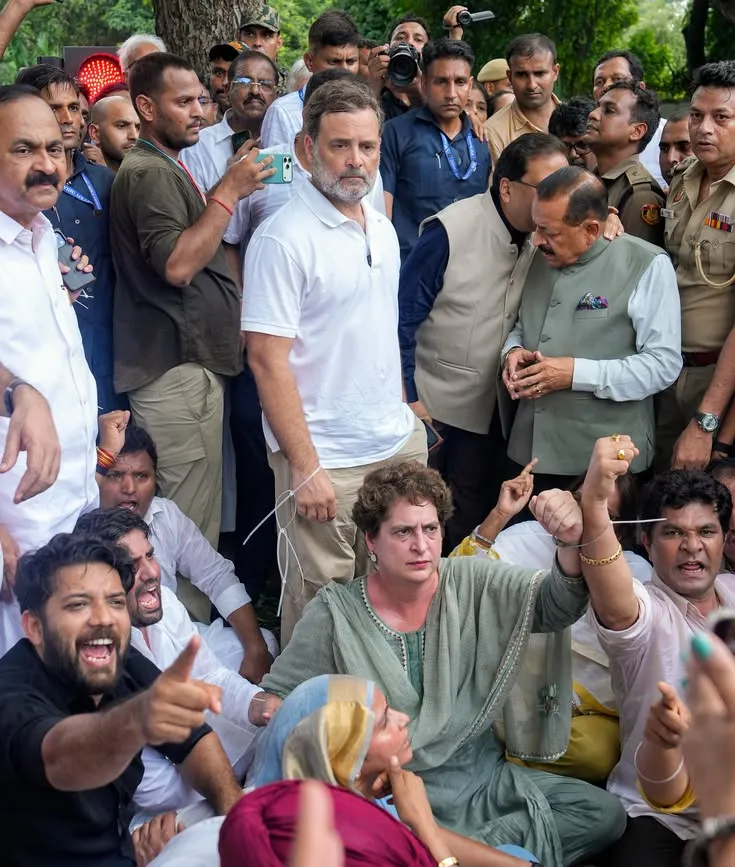
Instead of remaining in the buses, Rahul and Priyanka Gandhi walked past the police cordon and entered the Akashvani Bhawan premises through the reception gate. They were accompanied by Congress MP Deepender Hooda. Once inside, they sat under a tree and refused requests from police officers to leave, insisting they still intended to reach the Election Commission office.
The sudden shift caught security personnel by surprise. Officers initially appeared uncertain how to respond. Other Congress leaders, including K.C. Venugopal and Pawan Khera, climbed the boundary wall of the building and began raising slogans in support. The sit-in inside the premises prolonged the confrontation and forced the police to redeploy personnel to the new location.
Congress Leaders Credit the Siblings
Senior Congress figures subsequently credited Rahul Gandhi and Priyanka Gandhi Vadra with derailing what they described as a clear police plan to disperse the protest and transport the MPs away from the area. One leader remarked that the demonstration would have concluded without the siblings’ unexpected action. The move, though off-script even for many within the party, kept the focus on the opposition’s demands for several additional hours.
The Gandhi siblings and other detained leaders were eventually released. The brief detentions did not prevent the opposition from framing the day’s events as a successful assertion of parliamentary voice against what they termed institutional bias in the electoral process.
Broader Context of the Dispute
The march formed part of a wider campaign launched by the INDIA bloc earlier in the month. At a meeting held days before the protest, alliance partners had agreed on a series of actions, including district-level marches, a formal approach to the President, and sustained pressure for the Chief Election Commissioner’s removal. The Special Intensive Revision exercise has become a flashpoint, with the opposition alleging that changes to electoral rolls risk disenfranchising legitimate voters and favour the ruling party. The Election Commission has maintained that the revision follows established procedures aimed at ensuring the accuracy of the rolls.
By the end of the day, the streets around Parliament and Akashvani Bhawan had returned to relative calm. Yet the images of barricade-climbing, bus detentions and the unplanned sit-in under a tree at the All India Radio headquarters ensured the protest remained the dominant political story. The Gandhis’ last-minute decision transformed a contained demonstration into a prolonged standoff, illustrating how individual initiative can still reshape the choreography of collective political action in the capital.
Read more – sportstatsflow.com

