
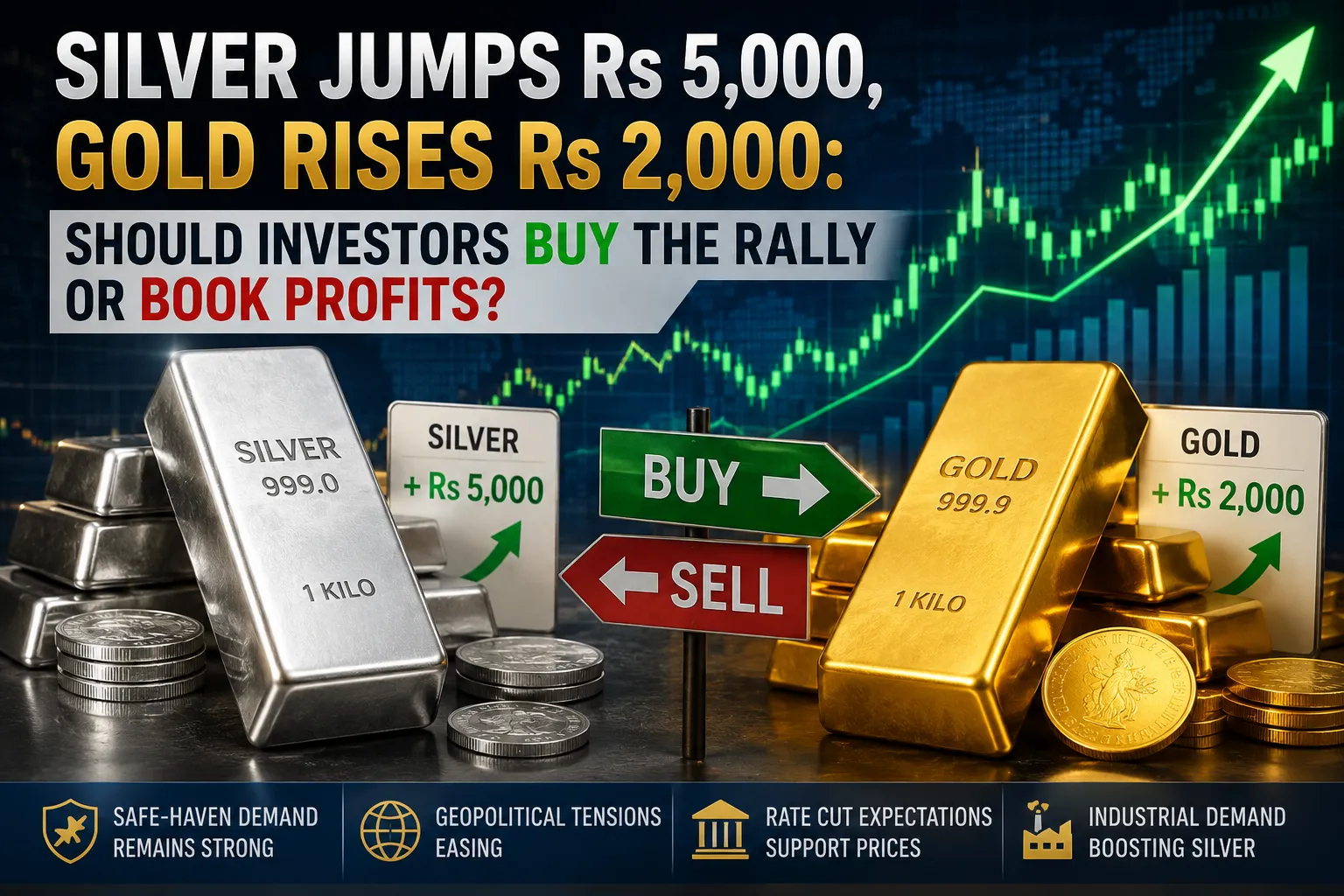
Precious metals made a strong comeback on Monday as both gold and silver recorded significant gains after a period of heightened volatility in global markets. Silver surged by more than Rs 5,000 on the Multi Commodity Exchange (MCX), while gold climbed nearly Rs 2,000, attracting fresh attention from investors, traders, and market analysts.
The sharp rise comes amid improving global sentiment, easing geopolitical concerns, and renewed investor interest in safe-haven assets. Developments related to US-Iran diplomatic discussions have also contributed to a more optimistic market outlook, influencing commodity prices worldwide.
As prices rally once again, a key question emerges for investors: Is this the right time to buy gold and silver, or should existing investors consider booking profits?
Understanding the factors behind the latest price movement can help investors make informed decisions in a rapidly changing market environment.
Precious Metals Stage a Strong Recovery
The latest rally marks a significant turnaround after recent fluctuations in commodity markets.
Gold and silver prices had experienced volatility due to changing expectations around interest rates, geopolitical developments, inflation concerns, and currency movements. However, renewed buying interest has pushed both metals higher.
Silver, known for its higher volatility compared to gold, recorded a particularly impressive jump. The metal often experiences sharper price swings because it serves both as a precious metal and an industrial commodity.
Gold, meanwhile, continued to demonstrate its role as a preferred store of value during periods of uncertainty. The nearly Rs 2,000 increase reflects growing investor confidence in precious metals despite recent market turbulence.
The strong recovery has sparked discussions among retail investors who are trying to determine whether the rally still has room to continue.
Why Gold and Silver Prices Are Rising
Several factors are contributing to the current surge in precious metal prices.
Improving Global Sentiment
Positive developments in international diplomacy have helped stabilize investor confidence. Reports regarding diplomatic engagement between the United States and Iran have reduced concerns about potential geopolitical escalation.
Whenever geopolitical tensions ease or intensify, commodity markets often react quickly. In this case, changing expectations regarding regional stability have influenced investment flows across asset classes.
Safe-Haven Demand Remains Strong
Even though market sentiment has improved, investors continue to seek protection against uncertainty.
Global economic growth concerns, inflation risks, and financial market volatility have encouraged many investors to maintain exposure to precious metals. Gold remains one of the world’s most trusted safe-haven assets during uncertain times.
Currency and Interest Rate Expectations
Expectations regarding central bank policies also influence precious metal prices.
When investors anticipate lower interest rates or slower monetary tightening, gold and silver often become more attractive. Since precious metals do not generate interest income, their appeal tends to increase when interest rates are expected to remain stable or decline.
Industrial Demand Supporting Silver
Silver benefits from an additional source of demand that gold does not enjoy to the same extent.
The metal plays a critical role in industries such as:
- Solar energy
- Electric vehicles
- Electronics manufacturing
- Semiconductor production
- Medical equipment
Growing global investment in renewable energy and advanced technology continues to support long-term silver demand.
Gold vs Silver: Which Metal Looks More Attractive?
Although both metals have risen sharply, their investment characteristics differ significantly.
Gold: Stability and Wealth Preservation
Gold has historically served as a store of value and a hedge against economic uncertainty.
Investors often allocate a portion of their portfolios to gold because it tends to perform relatively well during periods of inflation, geopolitical instability, and financial market stress.
Advantages of gold include:
- Lower volatility compared to silver
- Strong global demand
- High liquidity
- Long-term wealth preservation
For conservative investors, gold remains one of the most reliable assets for portfolio diversification.
Silver: Higher Risk, Higher Potential
Silver typically experiences larger price fluctuations than gold.
Because silver benefits from both investment and industrial demand, it can outperform gold during periods of strong economic growth and technological expansion.
Advantages of silver include:
- Strong industrial demand
- Potential for faster price appreciation
- Lower entry cost compared to gold
- Growing relevance in green energy sectors
However, investors should remember that silver’s volatility can result in larger short-term losses as well as gains.
Should Investors Buy at Current Levels?
The answer depends largely on an individual’s investment goals, risk tolerance, and time horizon.
Reasons to Consider Buying
Long-Term Demand Remains Strong
Both gold and silver continue to benefit from structural demand drivers.
Gold remains a preferred hedge against inflation and uncertainty, while silver’s industrial applications continue to expand due to technological and renewable energy developments.
Portfolio Diversification
Financial experts generally recommend holding a portion of investment portfolios in precious metals.
Adding gold or silver can help reduce overall portfolio risk by providing exposure to assets that often behave differently from stocks and bonds.
Economic Uncertainty Persists
Despite recent positive developments, several uncertainties remain in the global economy, including inflation concerns, geopolitical tensions, and fluctuating growth forecasts.
These factors continue to support precious metal demand.
Reasons to Exercise Caution
Prices Have Already Risen Sharply
After a strong rally, short-term profit-taking can sometimes trigger temporary corrections.
Investors entering at higher levels should be prepared for potential volatility.
Market Sentiment Can Change Quickly
Commodity markets are highly sensitive to geopolitical developments, economic data releases, and central bank announcements.
Any major shift in these factors could influence precious metal prices.
Avoid Emotional Buying
Many retail investors rush into markets after seeing sharp price increases.
Experts generally advise against making investment decisions based solely on recent price movements. A disciplined strategy often produces better long-term results than chasing momentum.
Is It Time to Book Profits?
For investors who purchased gold or silver at lower levels, the recent rally may present an opportunity to review their positions.
Profit booking is not necessarily a sign of bearishness. Instead, it can be part of a disciplined investment strategy.
Consider booking partial profits if:
- Your investment allocation has become too large.
- You have achieved your target returns.
- You require liquidity for other financial goals.
- Your portfolio has become overly concentrated in precious metals.
Many financial planners recommend partial profit booking rather than exiting entirely, allowing investors to retain exposure while securing gains.
What Strategy Makes Sense Now?
Rather than viewing the situation as a simple “buy or sell” decision, investors may benefit from a balanced approach.
For New Investors
Instead of investing a large amount at once, consider staggered purchases over time. This strategy can help reduce the impact of short-term price fluctuations.
For Existing Investors
Review your portfolio allocation and determine whether your precious metal exposure aligns with your financial objectives.
For Long-Term Investors
Focus on long-term fundamentals rather than short-term market movements. Gold and silver continue to play important roles in diversified investment portfolios.
Outlook for Gold and Silver
Market analysts remain cautiously optimistic about precious metals over the medium to long term.
Several factors could continue supporting prices:
- Ongoing geopolitical uncertainty
- Central bank gold purchases
- Inflation concerns
- Growth in renewable energy demand
- Industrial expansion supporting silver consumption
- Potential shifts in global monetary policy
At the same time, investors should remain aware of risks such as stronger economic growth, rising interest rates, or changes in market sentiment that could temporarily pressure prices.
Conclusion
The sharp rise in gold and silver prices has once again highlighted the importance of precious metals in today’s investment landscape. Silver’s jump of more than Rs 5,000 and gold’s gain of nearly Rs 2,000 demonstrate strong investor interest amid changing global conditions.
Whether investors should buy or sell depends largely on their individual goals and risk appetite. Long-term investors may still find value in maintaining exposure to precious metals, while those sitting on significant gains may consider partial profit booking as part of a disciplined strategy.
Rather than chasing short-term price movements, investors should focus on portfolio diversification, risk management, and long-term financial objectives. In a world marked by economic uncertainty and evolving market conditions, gold and silver continue to serve as important tools for preserving and growing wealth.
