
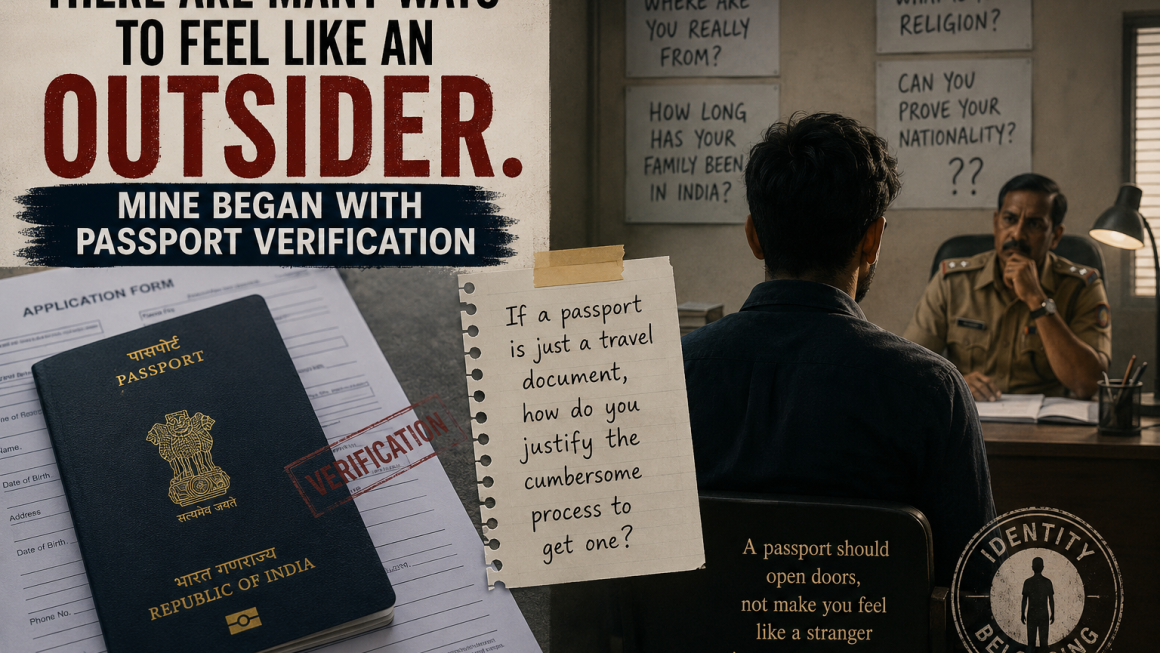
A passport is widely recognized as an essential travel document that enables citizens to cross international borders. However, for many people, obtaining a passport involves much more than completing an application or submitting photographs. It can become an emotional journey shaped by documentation, verification procedures, and interactions with government authorities.
Recently, public discussions intensified after the Ministry of External Affairs (MEA) clarified that a passport is primarily a travel document and should not automatically be treated as proof of citizenship. While the clarification was made within a legal and administrative context, it also revived broader conversations about the passport verification process and the experiences of applicants who often find themselves answering deeply personal questions during police verification.
For some citizens, the verification process is straightforward and uneventful. For others, however, it can feel less like a routine administrative procedure and more like an examination of identity, belonging, and trust. These experiences have prompted important questions about how governments balance national security with citizen convenience and dignity.
Understanding the Purpose of Passport Verification
Passport verification exists for legitimate reasons.
Governments around the world verify the identity and background of applicants before issuing passports. The objective is to ensure that travel documents are issued only to eligible individuals, helping prevent identity fraud, document forgery, human trafficking, and other forms of misuse.
In India, the passport issuance process generally includes document verification, address confirmation, and, in many cases, police verification. The police verification process is intended to confirm that the applicant resides at the declared address and that the information provided in the application is accurate.
From an administrative perspective, these checks strengthen the integrity of one of the country’s most important identity-related documents.
When Verification Feels Personal
Although the verification process serves an important public purpose, the experience can vary significantly from one applicant to another.
Many applicants report smooth interactions with local authorities. Others, however, describe situations where routine questions evolve into prolonged discussions about family background, migration history, language, religion, or nationality.
When this happens, individuals may feel that they are being asked to prove not merely their identity but their legitimacy as citizens.
For applicants whose families have migrated across states or international borders over previous generations, or whose names, accents, or cultural backgrounds differ from local expectations, such questioning can become emotionally difficult.
Even when officials are performing their duties within procedural guidelines, the manner in which questions are asked can influence how applicants perceive the entire experience.
The Ministry’s Clarification and Public Debate
The recent clarification by the Ministry of External Affairs that a passport is fundamentally a travel document generated widespread discussion.
Legally, the statement reflects an important distinction. Citizenship in India is governed by constitutional provisions and citizenship laws, while passports are issued under separate legislation that regulates international travel.
This means that possessing a passport does not automatically resolve every legal question concerning citizenship in all possible circumstances.
However, for many citizens, the clarification appeared difficult to reconcile with the extensive verification procedures involved in obtaining a passport.
If obtaining a passport requires detailed document verification, police inquiries, and identity confirmation, many people naturally wonder why the document is not universally accepted as definitive proof of citizenship in every administrative context.
This distinction between legal definitions and public perception continues to generate debate.
Why Verification Is Becoming More Important
Modern governments face increasingly complex security challenges.
Identity fraud, forged documents, cybercrime, illegal migration, organized crime, and international security concerns require stronger verification systems than ever before.
As a result, passport authorities have adopted more sophisticated methods for confirming applicants’ identities.
Today’s verification process often involves:
- Digital application systems
- Aadhaar and document verification
- Police verification
- Biometric records
- Address confirmation
- Cross-checking government databases
These measures help reduce fraud while improving the credibility of Indian passports internationally.
From a policy perspective, stronger verification contributes to greater trust in official documents.
The Human Side of Administrative Procedures
Administrative efficiency is only one aspect of public service.
Equally important is the way citizens experience government processes.
A respectful, transparent, and consistent verification procedure can strengthen public confidence in institutions. Conversely, interactions that appear unnecessarily intrusive or inconsistent may leave applicants feeling anxious or alienated.
Public administration experts often emphasize that citizens should be treated as participants in governance rather than subjects of suspicion.
Simple improvements in communication, professionalism, and procedural clarity can significantly enhance public experiences without compromising security standards.
Identity Beyond Documents
The passport debate also raises broader questions about identity.
For many people, identity is shaped not only by official records but also by family history, language, culture, education, community, and lived experience.
When individuals are repeatedly asked to explain their origins or justify their belonging, administrative procedures can become emotionally significant.
This is particularly true for citizens belonging to minority communities, people whose families have migrated internally within India, or those living in regions with complex historical migration patterns.
Even when verification is conducted lawfully, sensitivity in communication remains essential.
Technology Can Improve Verification
India has made significant progress in digitizing government services.
Passport applications have become faster through online portals, appointment systems, digital tracking, and integrated document verification.
Technology offers opportunities to further improve the verification process.
Potential improvements include:
Better Digital Integration
Greater coordination between government databases could reduce the need for repeated document submissions.
Standardized Verification Procedures
Uniform guidelines may help ensure consistency across different regions.
Faster Processing
Automation can reduce waiting times while maintaining security standards.
Improved Applicant Communication
Providing clear explanations regarding verification requirements helps reduce confusion and anxiety.
Digital transformation can make verification both more efficient and more citizen-friendly.
Balancing Security and Citizen Rights
Every country must strike a balance between national security and individual rights.
Robust verification procedures help protect public interests, but they should also respect citizens’ dignity and privacy.
Good governance requires both accountability and empathy.
Officials conducting verification play an important role in representing public institutions. Their professionalism and communication skills contribute significantly to public trust.
Similarly, applicants benefit from understanding why certain questions are asked and how their information is used.
Transparency on both sides strengthens confidence in the system.
Lessons from Public Experiences
Personal accounts shared by passport applicants provide valuable feedback for policymakers.
While individual experiences cannot always represent the entire system, they highlight areas where improvements may be possible.
Common themes include:
- Need for greater procedural transparency
- Consistent implementation across jurisdictions
- Better public awareness of verification requirements
- Respectful communication during police interactions
- Reduced administrative delays
Listening to citizen experiences allows governments to refine public services while preserving necessary security measures.
Why Public Trust Matters
Trust is one of the most valuable assets in any administrative system.
Citizens are more likely to cooperate with verification procedures when they believe the process is fair, impartial, and respectful.
Conversely, perceptions of inconsistency or unnecessary scrutiny can weaken confidence even if procedures are legally justified.
Building trust requires:
- Clear communication
- Efficient services
- Fair treatment
- Accountability
- Transparency
These principles strengthen both governance and public participation.
Conclusion
The debate surrounding passport verification extends beyond administrative procedures. It touches fundamental questions about identity, citizenship, belonging, and the relationship between citizens and the state.
The Ministry of External Affairs’ clarification that passports primarily function as travel documents reflects an important legal distinction. At the same time, the extensive verification process required to obtain a passport naturally leads many citizens to question how such a rigorously issued document fits into broader discussions of identity and citizenship.
As governments continue strengthening security systems in an increasingly complex world, ensuring that verification processes remain transparent, efficient, and respectful will be equally important. Administrative procedures should protect national interests without leaving citizens feeling like outsiders in their own country.
Ultimately, the most effective public institutions are those that combine strong security measures with empathy, professionalism, and respect for the people they serve. A passport may legally be a travel document, but for many citizens, the journey to obtain one represents something far more personal—the recognition of identity, belonging, and trust in the institutions of their nation.
