
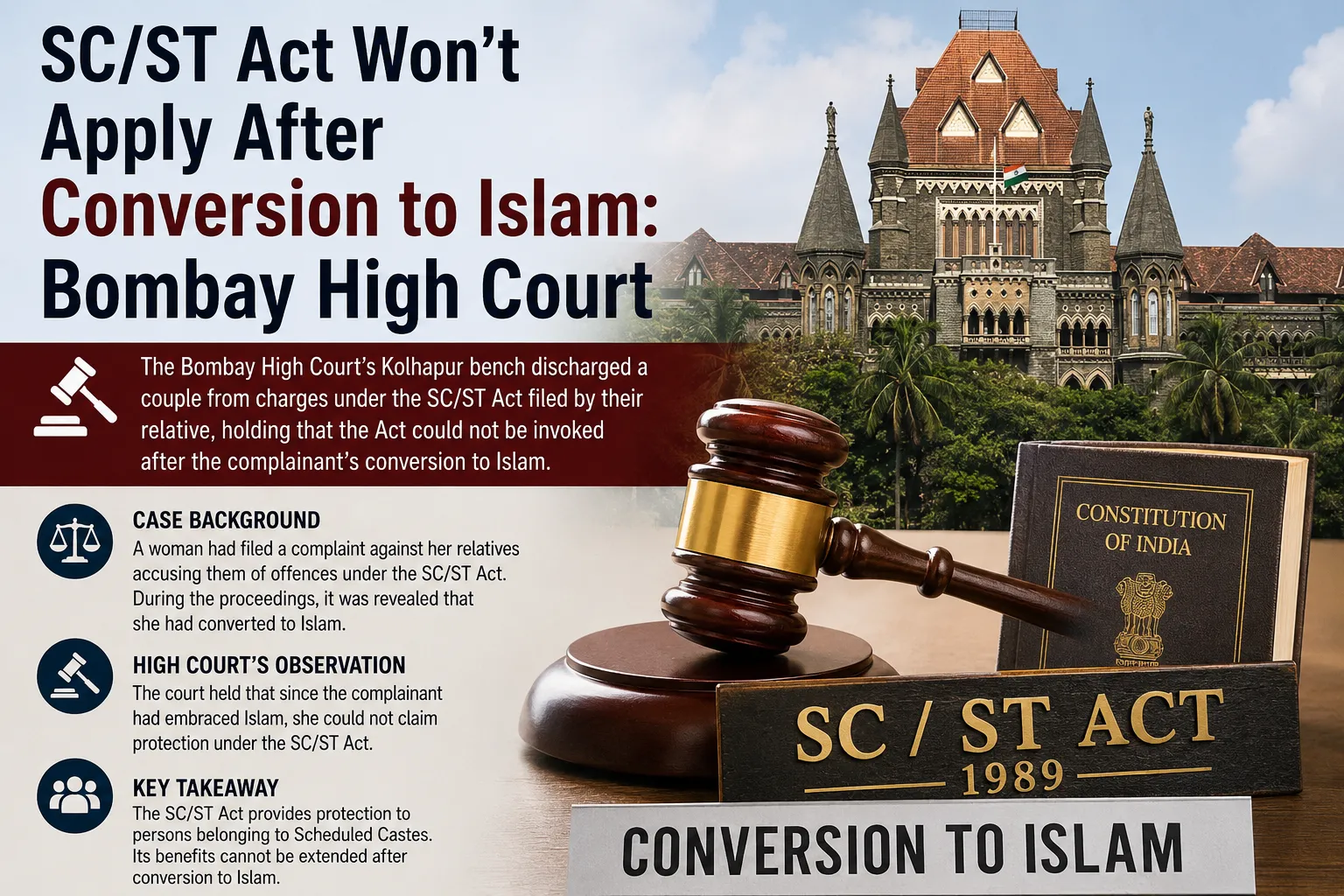
The Bombay High Court’s Kolhapur Bench has delivered an important judgment concerning the applicability of the Scheduled Castes and Scheduled Tribes (Prevention of Atrocities) Act, commonly known as the SC/ST Act. In its ruling, the Court discharged a couple who had been facing charges under the Act after observing that the complainant had converted to Islam and, therefore, could not invoke the protections available under the legislation in the circumstances of the case.
The judgment has attracted considerable attention because it touches upon the intersection of constitutional law, religious conversion, caste identity, and statutory protections. While the decision is specific to the facts presented before the Court, it has sparked wider discussions about how personal law, constitutional provisions, and special legislations interact when questions of religious conversion arise.
Understanding the ruling requires an examination of the purpose of the SC/ST Act, the legal framework governing Scheduled Caste status, and the constitutional principles that guided the Court’s reasoning.
Background of the Case
The matter originated from a complaint filed by a woman against her relatives, accusing them of committing offences under the Scheduled Castes and Scheduled Tribes (Prevention of Atrocities) Act.
The complaint was registered before the Adityapur police station, and criminal proceedings were initiated against the accused couple.
During the proceedings, it emerged that the complainant had converted to Islam before the alleged incident. The accused challenged the applicability of the SC/ST Act, arguing that the complainant could no longer claim protection under the legislation after changing her religion.
The case eventually reached the Kolhapur Bench of the Bombay High Court, where the judges examined both the factual background and the relevant constitutional and statutory provisions before delivering their decision.
What the Bombay High Court Held
After hearing the arguments from both sides, the High Court discharged the accused from offences under the SC/ST Act.
The Court held that the protections available under the Act could not be invoked in the particular circumstances because the complainant had embraced Islam. The judgment relied upon the constitutional and legal framework governing Scheduled Caste status and the applicability of statutory protections linked to that status.
It is important to note that the Court’s decision concerned the applicability of the SC/ST Act and did not determine the merits of every allegation made by the complainant under other laws.
The ruling therefore addressed a specific legal question rather than broader issues relating to criminal liability.
Understanding the SC/ST Act
The Scheduled Castes and Scheduled Tribes (Prevention of Atrocities) Act, 1989, was enacted to prevent offences committed against members of Scheduled Castes and Scheduled Tribes.
The legislation provides enhanced legal protection against caste-based discrimination, violence, intimidation, humiliation, social exclusion, and other atrocities.
It also establishes special courts, speedy investigation procedures, victim compensation, and other safeguards designed to protect historically marginalized communities.
The Act is regarded as one of India’s most significant social justice legislations because it seeks to address longstanding patterns of caste-based discrimination and violence.
Scheduled Caste Status and Religious Conversion
One of the central legal issues in the case relates to the constitutional framework governing Scheduled Caste status.
Under the Constitution (Scheduled Castes) Order, 1950, Scheduled Caste status is generally recognized for persons professing Hinduism. Later amendments extended similar recognition to Sikhs and Buddhists belonging to Scheduled Castes.
However, individuals who convert to religions such as Islam or Christianity are generally not treated as Scheduled Caste members under the existing constitutional framework unless specific legal provisions apply.
This distinction has been the subject of judicial interpretation over several decades and has influenced multiple court decisions across India regarding reservation benefits, statutory protections, and caste-based entitlements.
The High Court considered these constitutional provisions while determining whether the SC/ST Act could be invoked in the present case.
Why the Judgment Matters
The ruling is significant because it clarifies how courts may interpret the relationship between religious conversion and statutory protections under the SC/ST Act.
The judgment reinforces the principle that courts must apply the law as enacted by Parliament and interpreted under the Constitution rather than extending statutory protections beyond their legal scope.
At the same time, the decision does not diminish the broader objective of protecting vulnerable communities from discrimination or violence.
Instead, it highlights the importance of determining whether the legal requirements for invoking a particular statute have been satisfied before criminal proceedings continue.
Constitutional Principles Behind the Decision
India’s Constitution guarantees every citizen the freedom to profess, practice, and propagate religion under Article 25.
Individuals therefore possess the constitutional right to convert from one religion to another, subject to applicable laws.
However, the legal consequences of religious conversion may differ depending upon the statute involved.
Certain constitutional benefits, reservation policies, and statutory protections are linked to legally recognized community status rather than religion alone.
Courts are therefore often required to determine how conversion affects eligibility under specific laws.
The Bombay High Court’s decision reflects this constitutional balancing exercise.
Judicial Interpretation of Caste and Religion
Indian courts have repeatedly observed that caste and religion, although often interconnected socially, are treated differently under various legal frameworks.
In several previous judgments involving caste certificates, reservation claims, and statutory benefits, courts have examined whether an individual continues to satisfy the legal requirements for claiming Scheduled Caste status after conversion.
Judicial decisions have emphasized that each case depends upon the applicable constitutional provisions, statutory language, and factual circumstances.
The present ruling follows this broader judicial approach by interpreting the law within its constitutional boundaries rather than expanding or restricting it beyond legislative intent.
Broader Legal Debate
The relationship between caste identity and religious conversion has remained a subject of legal, academic, and public debate for many years.
Some scholars argue that social discrimination may continue even after conversion because historical caste identities often persist within society.
Others maintain that constitutional provisions governing Scheduled Castes must be applied exactly as enacted until Parliament decides otherwise.
Questions concerning reservation policies, statutory protections, and conversion have also been considered in various courts, including the Supreme Court, making this an evolving area of constitutional jurisprudence.
The Bombay High Court’s judgment contributes to this continuing legal discussion.
Implications for Future Cases
Although the ruling is important, its application should not be viewed as universal for every dispute involving conversion.
Each criminal case depends upon its own facts, evidence, applicable statutory provisions, and judicial interpretation.
Courts examine individual circumstances before deciding whether specific offences under the SC/ST Act are legally maintainable.
The judgment nevertheless provides guidance regarding how constitutional provisions relating to Scheduled Caste status may influence future litigation involving similar questions.
Law enforcement agencies and lower courts may also consider this interpretation while examining comparable complaints.
Balancing Social Justice and Legal Certainty
One of the judiciary’s primary responsibilities is balancing social justice objectives with faithful interpretation of the law.
Special legislations like the SC/ST Act exist to protect historically disadvantaged communities and strengthen constitutional equality.
At the same time, criminal prosecutions must satisfy the precise legal requirements established by Parliament.
The High Court’s decision demonstrates this balance by acknowledging the importance of the legislation while also ensuring that its provisions are applied within the framework established by the Constitution.
Such judicial scrutiny helps maintain both fairness and legal certainty.
Conclusion
The Bombay High Court’s decision to discharge the accused couple in a case filed under the SC/ST Act represents an important interpretation of how constitutional provisions relating to Scheduled Caste status interact with religious conversion. By holding that the Act could not be invoked after the complainant’s conversion to Islam in the facts before it, the Court clarified the legal boundaries governing the application of this special legislation.
The ruling does not alter the broader purpose of the SC/ST Act, which remains a vital safeguard against caste-based discrimination and atrocities. Instead, it highlights the judiciary’s role in ensuring that statutory protections are applied consistently with constitutional provisions and established legal principles. As debates surrounding caste, religion, and constitutional rights continue, judgments such as this contribute to the ongoing development of India’s legal framework while reinforcing the importance of careful judicial interpretation.
