Dabur India has approached the Delhi High Court challenging an order by the Food Safety and Standards Authority of India that directed the company to immediately stop selling several food products carrying “100 per cent” claims. The FMCG major has argued that the regulator’s action violates the principles of natural justice because it was issued without a prior show-cause notice or an opportunity to be heard.
The FSSAI Directive
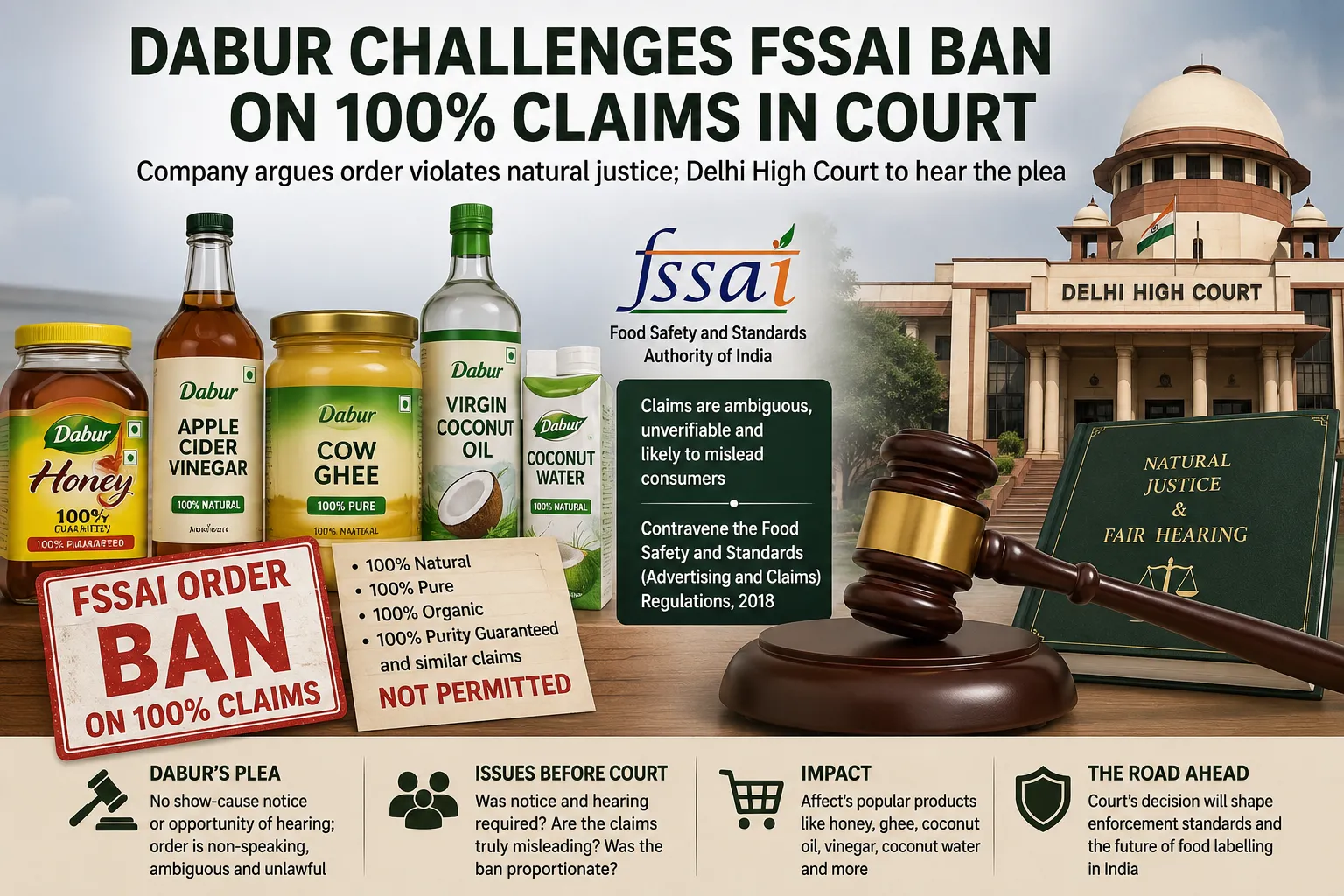
Earlier this week, FSSAI issued a prohibition order against Dabur covering products sold with claims such as “100 per cent natural,” “100 per cent pure,” “100 per cent purity guaranteed,” “100 per cent organic” and similar absolute statements. The list of affected items includes honey, apple cider vinegar, virgin coconut oil, sesame oil, cow ghee, coconut water, coconut milk and certain other food products available on the company’s website and in the market.
According to the regulator, such absolute claims are ambiguous, unverifiable and likely to mislead consumers. FSSAI stated that they contravene the Food Safety and Standards (Advertising and Claims) Regulations, 2018. The authority also raised concerns about the use of the Jaivik Bharat logo on some products without valid organic endorsement and noted that certain claims were not permitted for compound foods.
FSSAI said it had earlier directed the company to discontinue the misleading claims but found the corrective action unsatisfactory. The fresh order required Dabur to stop sale of the identified products immediately and submit an action-taken report within 15 days.
Dabur’s Legal Challenge
On Thursday, Dabur moved the Delhi High Court. Senior counsel appearing for the company mentioned the matter for urgent listing. The petition is scheduled to be heard by Justice Swarana Kanta Sharma.
In its plea, Dabur has contended that the prohibition order was passed in violation of the principles of natural justice and applicable statutory provisions. The company has stated that the FSSAI neither issued a prior show-cause notice nor provided an opportunity of hearing before imposing the ban. It has further argued that the regulator lacks the power to pass such a prohibitory order in the manner adopted, and that the order itself is non-speaking, ambiguous and issued without proper application of mind.
Dabur has also pointed out that the expression “100 per cent” is used across several categories of food products by other major players. The company has objected to the public manner in which the order was announced, stating that it has created a negative impression of the brand. The petition seeks judicial intervention against the directive and the restrictions placed on the sale of the concerned products.
Company’s Parallel Response
In communications to the stock exchanges and during its annual general meeting, Dabur has maintained that the notice pertains to the industry-wide use of the term “100 per cent” and does not question the quality, safety or standards of its products. The company has said that most of the affected products have already transitioned to revised labels and advertisements without the absolute claims, or are in the process of doing so. It has expressed willingness to collaborate with the regulator while also seeking legal advice on the future course of action.
Broader Regulatory Context
Absolute claims on food labels have long been a sensitive area for regulators. Phrases that suggest complete purity or naturalness can create strong consumer impressions, yet they are often difficult to substantiate fully across every stage of sourcing, processing and packaging. The 2018 Advertising and Claims Regulations aim to ensure that marketing statements remain truthful, unambiguous and capable of verification.
FSSAI’s action against Dabur forms part of a wider effort to scrutinise labelling practices that may overstate product attributes. Similar concerns have been raised in the past regarding organic claims, purity declarations and the use of certification logos. The regulator’s insistence on verifiable language reflects an attempt to reduce the gap between what labels promise and what can be independently confirmed.
Issues Before the Court
The Delhi High Court will examine both the procedural and substantive dimensions of the dispute. On the procedural side, the central question is whether FSSAI was required to issue a show-cause notice and grant a hearing before passing a prohibitory order of this nature. Principles of natural justice generally require that a party be given notice of the case against it and a fair opportunity to respond, particularly when the action affects ongoing business operations and brand reputation.
On the substantive side, the court may consider the scope of FSSAI’s powers under the relevant regulations, the precise meaning of “ambiguous and unverifiable” claims, and whether the blanket prohibition was proportionate. The industry-wide prevalence of similar language, which Dabur has highlighted, could also form part of the discussion on consistency of enforcement.
Implications for Consumers and Industry
For consumers, the case underscores the need for careful reading of food labels. Absolute claims can simplify purchasing decisions, yet they may not always capture the complexities of food production. Regulatory pushback against such language is intended to encourage more precise and substantiated marketing.
For the food industry, the dispute serves as a reminder that labelling practices remain under active scrutiny. Companies that have relied on strong purity or naturalness claims may need to review their packaging and advertising in light of the regulator’s position. At the same time, the legal challenge raises questions about the process that must precede enforcement action of this scale.
The Road Ahead
The Delhi High Court’s hearing will provide the first judicial examination of FSSAI’s order. Depending on the outcome, the matter could lead to a stay, a direction for fresh proceedings with proper notice, or an affirmation of the regulator’s approach. In the interim, Dabur has indicated that it is already moving products away from the contested claims.
The case brings into focus the balance between consumer protection and fair procedure. FSSAI has acted to curb what it views as misleading absolute claims. Dabur has responded by asserting that the manner of that action itself violated established legal principles. The court’s eventual decision will influence not only the immediate fate of the affected products but also the standards that govern how food regulators and companies interact when labelling disputes arise.
Read more – laicaicai.com