
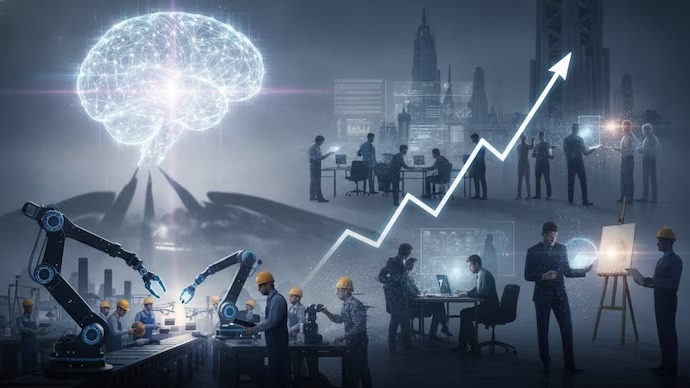
India’s AI Job Market Is Changing Fast
Artificial intelligence is no longer sitting quietly inside technology companies in India, because it is now moving into banking, healthcare, retail, manufacturing, education, media, and even smaller businesses. Companies are using AI tools to handle repetitive work, study customer behaviour, create software, analyse information, and speed up everyday operations.
That shift has created an interesting situation for Indian workers. Instead of simply destroying jobs, AI is also opening new roles around the technology. The bigger question is not whether AI will create employment, because it already is doing that in several areas. The real question is whether workers can develop the skills needed for those new opportunities.
Recent discussions around India’s artificial intelligence economy point toward strong demand for AI-related skills, especially as companies experiment with generative AI and automation. The country already has a large technology workforce, which gives India a strong starting point for this transformation.
Still, there is a catch that should not be ignored.
New Jobs Are Not Always Familiar Jobs
When people hear that AI is creating jobs, they often imagine traditional employment returning in a different form. That is not exactly what is happening across the market.
Many new positions require workers to understand AI systems, data, automation, software, cloud platforms, cybersecurity, or specialised business processes. Some roles are completely new, while others are older jobs that now require additional technical abilities.
For example, companies need people who can manage AI systems, check AI-generated information, build automated workflows, prepare data, monitor models, and make sure technology follows business and legal requirements. There is also growing demand for workers who understand both technology and specific industries.
This creates a strange gap in the employment market. Jobs may be available, but the people searching for work may not have the required skills yet.
That difference could become one of India’s biggest employment challenges over the next few years.
AI Is Boosting Certain Career Opportunities
The rise of AI is producing opportunities across several different professional areas. Software development remains one obvious example, although the nature of programming work is changing quickly.
Developers increasingly use AI assistants to write code, identify errors, generate documentation, and speed up repetitive development tasks. This does not necessarily remove the developer from the process, because somebody still needs to understand the system and verify what the AI produces.
Data-related careers are also becoming increasingly important for businesses. Companies generate enormous amounts of information, but raw information has little value without proper analysis and interpretation.
AI-related roles are appearing in marketing departments as well. Businesses need professionals who can use AI tools for research, content planning, customer segmentation, advertising analysis, and campaign optimisation.
There are also opportunities in AI safety, cybersecurity, model testing, compliance, and governance. As organisations become more dependent on AI systems, they need people who can identify mistakes and manage potential risks.
The Catch Is The Skills Gap
This is probably the most important part of the entire AI employment story.
India has millions of workers who are capable of learning new technologies, but having a large workforce does not automatically mean having an AI-ready workforce. The technology is moving quickly, while education and training systems usually change much more slowly.
A worker who has spent years performing repetitive administrative tasks could suddenly face software capable of completing much of that work within minutes. At the same time, the company may need someone who knows how to operate, monitor, or improve that software.
Those are two very different skill sets.
Reskilling therefore becomes extremely important. Employees who learn how AI affects their industry could become more valuable, while people who completely ignore the shift may find their existing responsibilities shrinking over time.
Entry-Level Workers Face A Different Problem
There is another issue that receives less attention when discussing AI and employment in India.
Many young workers traditionally enter companies through basic tasks. They learn gradually by handling repetitive assignments before moving toward more complicated responsibilities.
AI can now perform some of those beginner-level tasks surprisingly well.
That could make the traditional career ladder less straightforward for fresh graduates. Companies may expect new employees to arrive with stronger analytical, technical, communication, and AI-related skills from the beginning.
This does not mean graduates will have no opportunities. It means the definition of being job-ready is changing.
A student who knows how to use AI responsibly, verify information, analyse results, communicate clearly, and solve practical problems could have an advantage over someone who only possesses theoretical knowledge.
Human Skills Still Matter Quite A Lot
Despite all the excitement around artificial intelligence, businesses cannot run entirely on automated systems.
Human judgement remains important when decisions involve customers, employees, money, strategy, ethics, and complicated situations. AI can produce recommendations, but someone still needs to understand whether those recommendations make sense.
Communication is another major advantage for workers. A person who can explain complicated technology in simple language may become valuable inside companies where technical and non-technical teams need to work together.
Leadership, negotiation, creativity, critical thinking, and problem-solving are also difficult to reduce to simple automated tasks. These abilities become even more useful when employees are working alongside AI rather than competing directly against it.
So the future worker may not necessarily be the person who knows everything about artificial intelligence. It could be the person who knows how to combine AI with strong human judgement.
Small Businesses Could Benefit Too
The AI employment story is not limited to large technology companies in Bengaluru, Hyderabad, Pune, Mumbai, or Gurugram.
Smaller Indian businesses are also gaining access to relatively inexpensive AI tools. A small retailer can use AI for customer communication, while a local service provider can automate appointment management and marketing work.
This could create demand for professionals who help traditional businesses adopt technology without needing massive technical teams.
Digital agencies, consultants, freelancers, and specialised service providers may find new opportunities as this adoption expands. Some workers could build careers by helping companies select AI tools, create workflows, train employees, or manage automated systems.
That creates an interesting employment possibility outside conventional IT jobs.
Some Existing Jobs Will Still Disappear
It would be misleading to suggest that AI creates jobs without destroying any.
Automation can reduce the need for certain repetitive responsibilities. Customer support, basic data entry, routine documentation, simple reporting, and some administrative processes are areas where businesses may increasingly use software.
The impact will not be identical everywhere, though. One company might use AI to reduce its workforce, while another might use the same technology to increase productivity and expand its operations.
The outcome depends on how businesses deploy the technology.
Workers should therefore avoid thinking about AI only as a job killer or only as a job creator. It can be both at the same time, sometimes inside the same organisation.
India Has A Major Opportunity Here
India has several advantages in the global AI race, including a large technology workforce, a growing startup ecosystem, strong software services expertise, and a huge domestic market.
If training programmes keep pace with technological changes, AI could create significant opportunities for Indian workers. Universities, companies, governments, and private training providers all have a role to play in making that happen.
The focus should not simply be on teaching people how to operate individual AI tools. Those tools can change within months.
Workers need broader capabilities that remain useful even when specific platforms become outdated. Understanding data, automation, technology, business processes, and responsible AI use can provide a stronger foundation.
That kind of flexibility may matter more than knowing one particular application.
What Workers Should Do Now
Employees do not necessarily need to become machine-learning engineers to prepare for an AI-driven workplace.
Someone working in marketing could learn AI-assisted research and analytics. A finance professional could explore automation and data tools. A content professional could learn AI-assisted workflows while improving editing and fact-checking abilities.
The goal should be to understand how AI can improve existing work rather than blindly chasing every new tool that appears online.
Workers should also pay attention to their industry’s direction. AI adoption in banking may look very different from AI adoption in manufacturing or healthcare.
Learning should therefore be practical and connected to actual workplace problems.
The Bigger Employment Picture
India’s AI transformation could eventually create more opportunities than it removes, but that outcome is not guaranteed for every worker.
The jobs being created can require different qualifications, different experience, and different ways of thinking. Someone losing a repetitive role today may not automatically qualify for a new AI-related position tomorrow.
That is where reskilling becomes the bridge between technological change and employment growth.
The companies that invest in their employees could benefit from a smoother transition. Workers who actively develop new capabilities could also protect themselves against sudden changes in their responsibilities.
The biggest opportunity may belong to people who treat AI as a workplace tool rather than something that must be either feared or blindly celebrated.
Conclusion
Artificial intelligence is changing India’s employment market in complicated ways, creating new opportunities while reducing demand for some repetitive responsibilities. The important point is that job creation alone does not guarantee that displaced workers can move smoothly into new positions. Skills, training, adaptability, and practical AI knowledge will increasingly determine who benefits from this transition. India has the workforce and technology ecosystem to gain significantly from the AI boom, but closing the skills gap will be essential. Workers and businesses should start preparing now instead of waiting for automation to reshape their roles completely.
Read more :-
