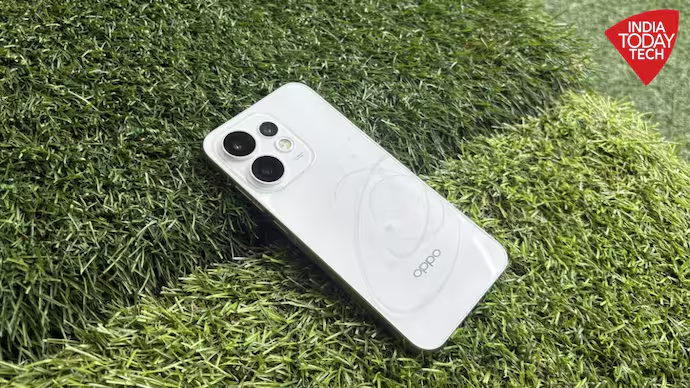
Design That Immediately Gets Attention
The OPPO Reno16 review starts with something that is difficult to ignore, the design. OPPO has clearly spent a lot of time making this phone look different from the usual glass slab smartphones. The Reno16 uses a slim body with a more compact feel, while the rear finish gives it a distinctive visual character that changes slightly when light hits the surface. OPPO describes the design language around cosmic inspiration, including its HoloVerse 3D technology and 3D Pop Planet styling.
The phone is available in Dream Purple, Twilight Violet, and Pop White variants, although exact colour availability can depend on the market. The Twilight Violet and Dream Purple versions weigh around 182 grams and measure roughly 8.22mm thick, which makes the phone reasonably comfortable for everyday handling.
A Compact Display With Plenty
The front of the Reno16 feels equally modern, mainly because of its 6.32-inch AMOLED panel. The display offers a 2640 × 1216 resolution, 120Hz refresh rate, and 10-bit colour depth, giving it a strong specification sheet for people who spend plenty of time watching videos or scrolling through social platforms.
OPPO also lists up to 1800 nits HBM brightness for this display, which should help when the phone is being used outside during brighter conditions. The 120Hz refresh rate is not exactly unusual anymore, but it still makes normal interactions feel noticeably smoother than older 60Hz panels.
The display has another nice advantage that does not always get enough attention. Its 460 PPI pixel density keeps text and smaller visual details looking sharp, particularly when reading articles, browsing websites, or looking through photographs.
Camera Setup Looks Seriously Interesting
Photography remains one of the biggest reasons people consider Reno smartphones, and the Reno16 takes that idea quite seriously. The rear setup includes a 50MP main camera with optical image stabilisation, a 50MP ultra-wide camera, and a 50MP telephoto camera with optical image stabilisation.
That combination gives the phone considerably more flexibility than devices that simply add low-resolution secondary sensors for marketing purposes. The ultra-wide camera has a 116-degree field of view, while the telephoto camera offers a 30-degree field of view and autofocus support.
The front camera is also a 50MP sensor, with autofocus and a 100-degree field of view. This could be particularly useful for group selfies because the wider framing gives you more room without forcing everyone to squeeze together awkwardly.
Video Features Are Not Forgotten
The OPPO Reno16 camera hardware becomes more interesting when video recording enters the picture. The rear camera can record 4K footage at both 60fps and 30fps, while electronic and optical stabilisation are supported for compatible recording modes.
The phone also supports 4K HDR video, professional video shooting, dual-view recording, and time-lapse modes. These additions make the camera system feel more complete rather than being focused only on taking quick social media photographs.
Even the front camera can record 4K video at up to 60fps. That is useful for creators who regularly record themselves, because the selfie camera does not feel like an afterthought compared with the rear camera system.
Performance Should Handle Daily Work
Under the hood, the Reno16 uses Qualcomm’s Snapdragon 7 Gen 4 Mobile Platform with an eight-core CPU and Adreno 722 GPU. OPPO pairs the processor with LPDDR5X RAM and UFS 3.1 storage.
On paper, that combination is aimed more toward balanced performance than extreme gaming performance. Everyday activities such as social media, streaming, web browsing, photography, multitasking, and office applications should fit comfortably within its capabilities.
Gaming performance will naturally depend on the particular title and graphics settings. Still, the Snapdragon platform gives the phone enough headroom for users who play games occasionally and do not want a device that starts feeling slow after opening several applications.
Battery Capacity Feels Sensible
Battery life is another area where the Reno16 looks properly prepared for modern smartphone use. The phone carries a 6700mAh typical battery, while 80W SUPERVOOC fast charging is supported.
That combination should appeal to people who dislike charging their phone repeatedly throughout the day. A larger battery is especially useful when the phone is being used for navigation, photography, video streaming, mobile data, and social applications.
Fast charging also matters because battery capacity alone does not solve everything. Being able to put the phone on charge for a relatively short period can be more convenient than carrying around a large battery that takes ages to refill.
The Software Experience Matters Too
Hardware is only half of the smartphone experience, and OPPO continues to put plenty of attention into its software ecosystem. The Reno16 is designed around OPPO’s modern ColorOS experience, with the company also introducing the AI Snap Key as part of the Reno16 design direction.
The AI Snap Key is particularly interesting because it represents a move toward making physical buttons more useful instead of simply keeping them limited to basic functions. OPPO has positioned it as a shortcut-focused feature for easier access to certain camera and AI-related functions.
Small features like these can sound less important on paper, but they sometimes become the things users actually appreciate after living with a phone for several weeks.
Slim Body Does Not Feel Boring
There is a common problem with modern smartphones, many of them look almost identical from a distance. The Reno16 tries to avoid that situation with its unusual rear styling and slim profile.
The cosmic-inspired finish is clearly intended to make the phone stand out in photographs and in real life. OPPO’s HoloVerse 3D approach adds another layer to the appearance, giving the back panel a more dynamic effect instead of relying only on a simple glossy colour.
This is probably where the phone earns the “out of this world” part of its description. It does not simply look expensive because of a large camera module or shiny frame. The design is doing most of the talking.
Is Reno16 Actually Worth Considering
The OPPO Reno16 review becomes easier to understand when you look at the phone as a complete package rather than focusing on one specification. You get a compact 6.32-inch AMOLED display, 120Hz refresh rate, Snapdragon 7 Gen 4 processing, a 6700mAh battery, 80W charging, and three 50MP rear cameras.
That is a fairly balanced setup for someone who wants a premium-looking smartphone without making gaming performance the only priority.
The biggest attraction, however, is still the design. People who buy Reno phones often care about appearance, cameras, selfies, and everyday usability just as much as raw benchmark numbers. The Reno16 seems to understand that audience very well.
Final Verdict On The Reno16
The OPPO Reno16 feels like a smartphone designed around more than just specification numbers. Its standout design, compact AMOLED display, versatile 50MP camera system, Snapdragon 7 Gen 4 platform, large 6700mAh battery, and 80W charging create a well-rounded package for everyday users.
The design is probably its strongest talking point, especially for buyers who want something that does not look like every other phone in the market. It also has enough camera and performance hardware to remain useful beyond basic daily tasks. Overall, the Reno16 looks like a strong choice for users who value style, photography, display quality, and reliable everyday performance together. For more smartphone reviews, specifications, and technology updates, keep following trusted tech coverage and compare the available options before making your purchase.
Read More :-