
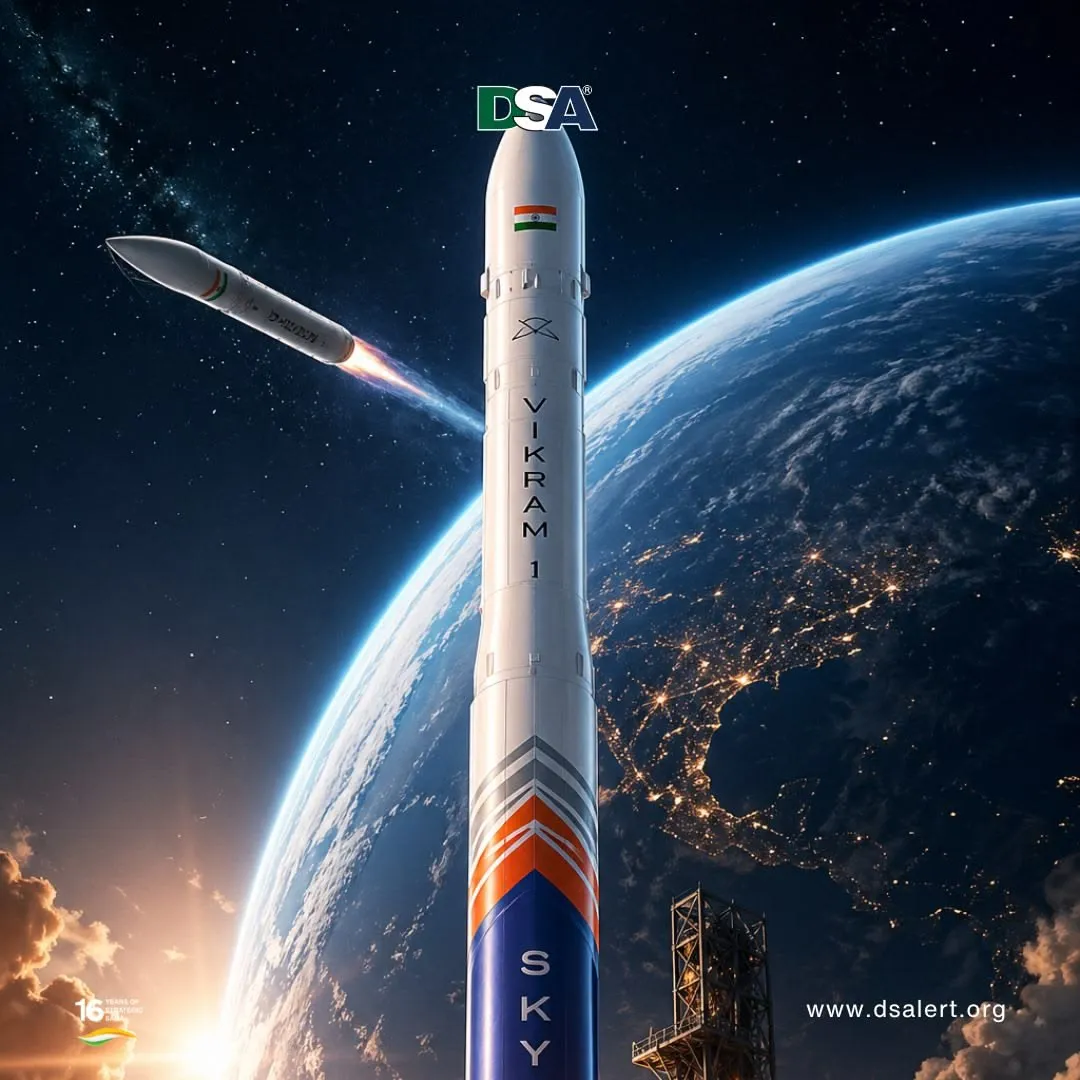
India’s private space industry is moving into its next phase as Skyroot Aerospace prepares for the second Vikram-1 launch. The Hyderabad-based space startup has sent the first stage of its second Vikram-1 rocket towards the Satish Dhawan Space Centre in Sriharikota, beginning preparations for another orbital mission just weeks after the company’s historic maiden flight.
The rapid transition from one completed orbital mission to preparations for another highlights Skyroot’s ambition to establish a more regular launch cadence. It also marks an important test of whether India’s emerging private space sector can move beyond a successful debut and develop the repeatability needed for sustained commercial launch operations.
Skyroot Moves First Stage of Second Vikram-1 to Sriharikota
Skyroot announced that Stage 1 of its second Vikram-1 vehicle was on its way to the spaceport at Sriharikota. The announcement came on National Space Day, adding significance to an update that represents a major step in the company’s post-launch plans.
The movement of the first stage does not mean that the second rocket is immediately ready for launch. Additional integration, testing and preparation will be required at the launch site before the complete vehicle can be prepared for flight.
The company has not announced a specific launch date or provided complete mission details for the second Vikram-1 mission. For now, the focus remains on moving hardware into position and continuing the preparation process.
Vikram-1’s Historic Maiden Orbital Flight
The second mission comes shortly after Vikram-1 achieved a major milestone for India’s private space sector.
On July 18, 2026, Vikram-1 lifted off from the Satish Dhawan Space Centre in Sriharikota. According to the Indian Space Research Organisation, the launch took place at 12:05:30 PM and represented the first time an Indian private company successfully conducted an orbital launch from Indian soil.
The achievement made Skyroot the first private company in India to successfully launch a rocket into orbit on its first attempt. Vikram-1 carried multiple payloads, including the SCOPE and Grahaa satellites, which were deployed into Low Earth Orbit. Other payloads remained on the upper stage for planned in-orbit experiments.
The successful mission was therefore more than a demonstration of Skyroot’s rocket technology. It represented the practical arrival of private orbital launch capability in India.
What Is Vikram-1?
Vikram-1 is an orbital-class small satellite launch vehicle developed by Skyroot Aerospace. The rocket was designed to place small satellites into Low Earth Orbit, a region of space widely used for Earth observation, communications, scientific missions and other applications.
The vehicle uses a four-stage architecture comprising three solid stages and a liquid stage. This combination allows different propulsion technologies to perform specific functions during the journey from the launch pad towards orbit.
The first mission provided Skyroot with important flight experience. The company can now use the knowledge and operational experience gained from that flight as it prepares its next vehicle.
From Vikram-S to Vikram-1
Skyroot’s progress did not begin with Vikram-1.
In November 2022, the company launched Vikram-S from Sriharikota in what was an important early step for India’s private rocket industry. That suborbital mission helped demonstrate the company’s ability to develop and launch a privately built rocket.
Vikram-1 represented a considerably larger ambition: reaching orbit and carrying satellites.
The successful 2026 orbital flight showed that the company had moved from experimental suborbital operations to an orbital launch capability. The preparation of a second Vikram-1 now indicates that Skyroot wants to continue building on that foundation rather than treating its first orbital mission as a one-time achievement.
Why the Second Launch Is So Important
A successful first launch is a significant accomplishment, but commercial space companies must demonstrate more than a single successful flight.
Satellite operators and other customers need confidence that a launch provider can deliver reliable services repeatedly. That makes the second Vikram-1 mission especially important.
The next flight can provide another opportunity to demonstrate the vehicle’s performance, validate production processes and strengthen operational experience. It can also help the company understand how efficiently it can move from one mission to the next.
For Skyroot, therefore, the second rocket is not merely another vehicle. It is part of the transition from demonstrating capability to establishing repeatable operations.
Faster Launch Cadence Could Strengthen Skyroot’s Position
The short gap between Vikram-1’s maiden orbital flight and the movement of the first stage of the second vehicle is notable.
Skyroot has described the development as moving “from one flight to the next”, reflecting its intention to maintain momentum after its historic first mission.
A faster launch cadence can be important in the competitive small-satellite launch market. Customers increasingly require launch opportunities that fit specific mission schedules rather than waiting for infrequent flights.
Developing a repeatable manufacturing, testing, integration and launch process can therefore become as important as developing the rocket itself.
Sriharikota Remains Central to India’s Private Space Push
Sriharikota has historically been associated with India’s national space programme, but the role of the spaceport is expanding as private companies gain greater access to national space infrastructure.
Skyroot’s first orbital launch was conducted with support from ISRO and IN-SPACe. ISRO provided access to facilities for solid-motor casting and static testing, while additional support covered areas such as stage preparation, transportation, vehicle integration and launch operations.
IN-SPACe has also played an important role in enabling non-government space companies to access facilities and obtain the necessary technical and regulatory support.
This collaboration illustrates how India’s space ecosystem is changing. Private companies are developing their own technologies while using an institutional framework and infrastructure that can help them move towards commercial operations.
The Bigger Picture for India’s Space Startup Ecosystem
Skyroot’s progress comes during a period of increasing private participation in India’s space sector.
Government reforms announced in 2020 opened the space industry to greater private involvement. Since then, Indian startups have increasingly worked on launch vehicles, satellites and space-based applications.
Vikram-1’s successful orbital mission demonstrated that private Indian companies can contribute directly to launch services. The preparation of a second vehicle now shifts attention toward the next challenge: building a sustainable launch business.
That involves more than rocket engineering. Companies need manufacturing capacity, testing infrastructure, mission planning, regulatory approvals, customer relationships and the ability to deliver launches consistently.
What Comes Next for the Second Vikram-1
The first stage’s movement to Sriharikota is an early step in a longer launch campaign.
At the spaceport, the vehicle will need to go through further preparation and integration. Other stages and the mission payload will also need to be brought together before the complete rocket can be readied for flight.
As of the latest announcement, Skyroot has not provided a confirmed launch date or detailed specifications for the second mission. That means expectations should remain focused on the preparation process rather than assuming a particular launch schedule.
Nevertheless, the arrival of the first stage is a clear indication that work on the next Vikram-1 is progressing.
From Historic Debut to Repeatable Space Operations
Skyroot Aerospace has already crossed one of the most important milestones for India’s private space industry: successfully reaching orbit with a privately developed rocket from Indian soil.
The next challenge is consistency.
The movement of the first stage of the second Vikram-1 to Sriharikota shows that the company is attempting to build momentum quickly after its maiden orbital success. If the next mission also performs successfully, it could strengthen confidence in Skyroot’s launch systems and support India’s broader ambition of becoming a competitive participant in the global commercial space market.
For now, the message from Skyroot is straightforward: the first orbital flight was not the destination. It was the beginning of a new phase in which repeat launches, reliability and operational efficiency will determine how far India’s private rocket industry can go.
Read more – lasandino.com

