
Treesa Jolly and Gayatri Gopichand have received a major reward for their breakthrough performance at the 2026 BWF World Championships, climbing 12 places in the latest women’s doubles rankings. The Indian pair moved from World No. 39 to No. 27 after securing a historic bronze medal at the tournament in New Delhi.
The ranking jump comes after one of the most significant performances by an Indian women’s doubles pair at the World Championships. Treesa and Gayatri entered the competition unseeded but produced a remarkable run against higher-ranked opponents, eventually becoming only the second Indian women’s doubles pair to win a World Championships medal.
Their achievement ended a 15-year wait for India in the women’s doubles category and has strengthened hopes that the pair can become a consistent force at the highest level of international badminton.
Treesa-Gayatri Rise to World No. 27
The latest BWF rankings have given the Indian duo a 12-place boost. They entered the World Championships ranked 39th in the world and are now ranked 27th. The jump is particularly significant because it places them firmly among the world’s top women’s doubles pairs.
The improvement also reflects the importance of their World Championships campaign. Ranking points earned through a deep run at one of badminton’s biggest tournaments can have a substantial impact on a player’s position.
For Treesa and Gayatri, the new ranking is more than just a number. It provides evidence of how quickly their standing in world badminton has changed after their historic performance on home soil.
A Historic World Championships Bronze
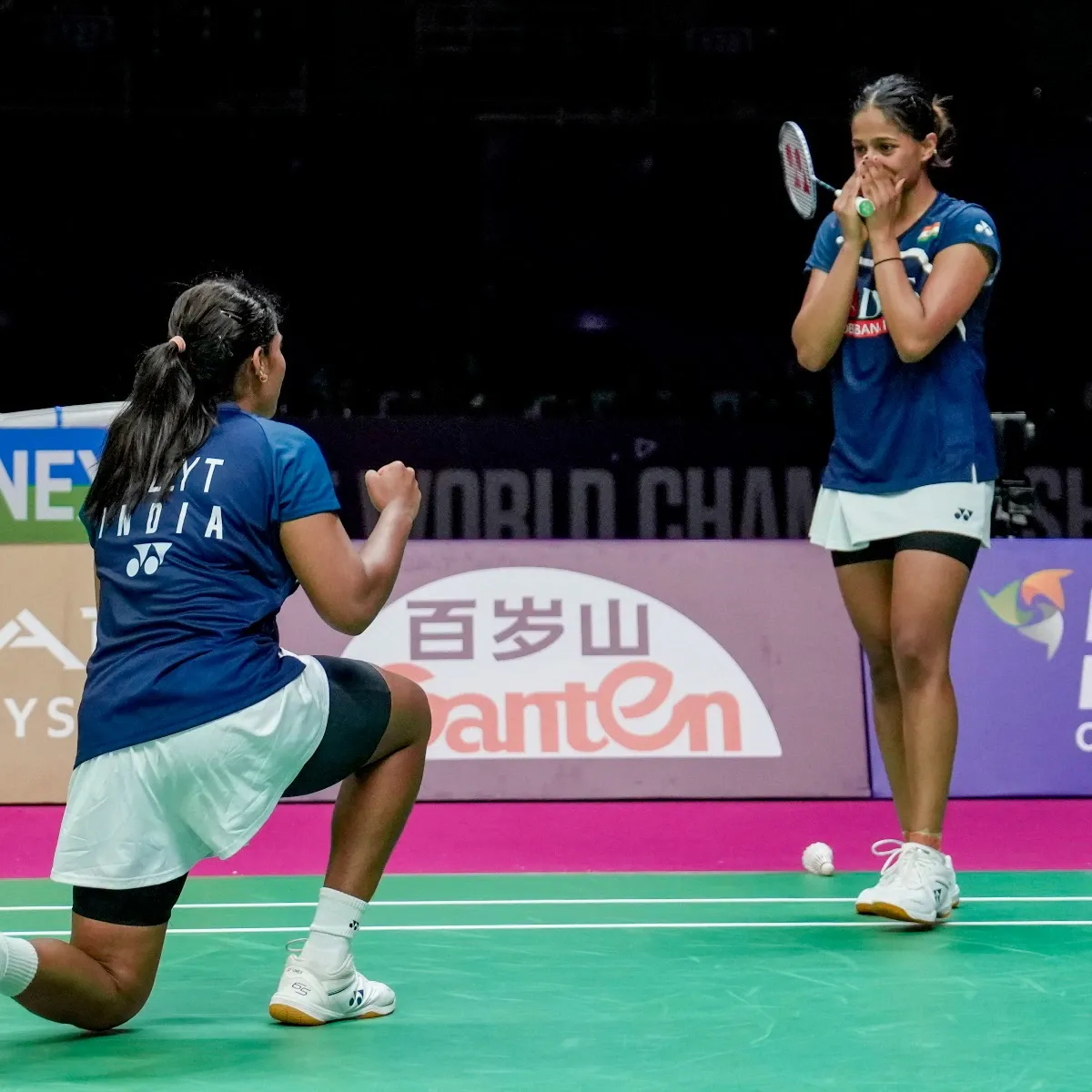
Treesa Jolly and Gayatri Gopichand secured the bronze medal after reaching the semifinals of the 2026 BWF World Championships.
Their journey came to an end against China’s Liu Sheng Shu and Tan Ning, the world No. 1 pair and defending champions. The Indian duo lost the semifinal 21-18, 13-21, 8-21 after more than an hour of competitive badminton.
Although they missed out on a place in the final, reaching the semifinals automatically guaranteed them a bronze medal. More importantly, the result ended India’s 15-year wait for a women’s doubles medal at the World Championships.
The last Indian women’s doubles pair to achieve the feat was Jwala Gutta and Ashwini Ponnappa, who won bronze in 2011. Treesa and Gayatri have now added their names to that short but important list.
The Quarterfinal Victory That Changed Everything
One of the defining moments of their campaign came in the quarterfinal against China’s Jia Yi Fan and Zhang Shu Xian, the fourth seeds.
Treesa and Gayatri recovered after losing the opening game to win 16-21, 21-15, 21-13. The comeback was especially impressive because they were facing a highly experienced and strongly ranked Chinese combination.
The victory guaranteed India a medal and immediately transformed the tournament for the unseeded pair.
Playing in front of a passionate home crowd at the Indira Gandhi Indoor Stadium in New Delhi, the duo showed composure after falling behind. Their ability to change momentum and stay patient became one of the biggest features of their campaign.
Why the Bronze Is So Important for Indian Badminton
India has developed a strong reputation in several badminton disciplines, particularly men’s doubles and men’s and women’s singles. Women’s doubles, however, has not always enjoyed the same consistency at the highest level.
The success of Treesa and Gayatri provides an important boost to the discipline.
Their medal continues the legacy created by Jwala Gutta and Ashwini Ponnappa and demonstrates that India can produce women’s doubles combinations capable of challenging established international pairs.
The achievement is also significant because the pair entered the World Championships without a seeding. Instead of being among the tournament favourites, they had to establish themselves match by match.
That makes their run even more impressive.
From Singles Players to a Successful Doubles Partnership
Treesa and Gayatri’s rise has an interesting element: both players originally had experience in singles before moving toward doubles.
Their partnership gradually developed into one of India’s most promising women’s doubles combinations. Their recent success shows how effectively they have adapted to the demands of doubles badminton, where communication, positioning, speed and tactical understanding are crucial.
Reports on their journey have highlighted how their partnership grew from an unexpected shift away from singles into a combination now capable of competing with the world’s leading pairs.
Their development is also a reminder that success in badminton does not always follow a straight path. Changing disciplines, finding the right partner and developing tactical chemistry can completely transform a player’s career.
Six Weeks of Focused Preparation
The World Championships medal was not simply the result of momentum during one tournament.
India’s chief national coach Pullela Gopichand said the pair’s performance was supported by a focused six-week preparation period. The work reportedly centred on improving their tactics, patience and belief.
That preparation became visible during their matches in New Delhi.
Rather than rushing points when under pressure, Treesa and Gayatri showed an ability to remain competitive and wait for opportunities. Their quarterfinal comeback against the Chinese fourth seeds was one of the clearest examples of that approach.
The medal therefore represents both natural talent and deliberate preparation.
Gayatri Gopichand’s Personal Milestone
For Gayatri Gopichand, the achievement carries an additional layer of significance because of her family background.
She is the daughter of former Indian badminton champion and national coach Pullela Gopichand. Her father’s reputation has inevitably brought additional attention and expectations throughout her career.
Coach B Sumeeth Reddy recently spoke about the pressure associated with being Pullela Gopichand’s daughter, describing it as a significant burden. The World Championships medal consequently represents more than a major sporting achievement; it also marks an important moment in Gayatri’s journey to establish herself on her own terms.
Her success alongside Treesa shows that the partnership is developing its own identity on the international circuit.
Gayatri and Treesa Believe They Can Go Further
The bronze medal has not reduced the pair’s ambitions.
Gayatri has said the result has strengthened her belief that she and Treesa can eventually become world champions. The confidence comes from the way they competed against some of the world’s strongest pairs during the tournament.
That ambition is important because their latest ranking of World No. 27 is not the end of the journey. Both players have previously reached the top 10, with the pair’s highest ranking being No. 9 in January 2025.
The latest ranking boost gives them a fresh platform from which to climb again.
What the Ranking Boost Means Going Forward
Moving from No. 39 to No. 27 can have practical importance beyond recognition.
A higher ranking can improve a player’s position in tournament draws and help establish greater consistency against elite opponents. It can also provide confidence after a breakthrough performance.
For Treesa and Gayatri, the priority will now be to convert their World Championships success into sustained results throughout the season.
The challenge is significant. International women’s doubles features several highly experienced partnerships, particularly from China, Japan, South Korea and other leading badminton nations.
However, the World Championships have shown that the Indian pair can compete at that level.
A New Chapter for Indian Women’s Doubles
Treesa Jolly and Gayatri Gopichand’s bronze is already an important chapter in Indian badminton history. Their 12-place jump to World No. 27 provides an immediate statistical reward for that achievement.
More importantly, their performance has changed expectations around Indian women’s doubles.
They defeated a fourth-seeded Chinese pair, reached the semifinals and challenged the world’s No. 1 team. They did so as an unseeded combination, in front of a home crowd and under the pressure of a major championship.
Their next objective will be consistency. A single medal can create attention, but repeated performances against the world’s best will determine whether this becomes the beginning of a long period at the top.
For now, however, Treesa Jolly and Gayatri Gopichand have earned their moment. Their historic bronze has ended a long wait for India, lifted them 12 places in the rankings and given Indian women’s doubles a fresh reason for optimism.
Read more – heraldwhig.com

