
Introduction
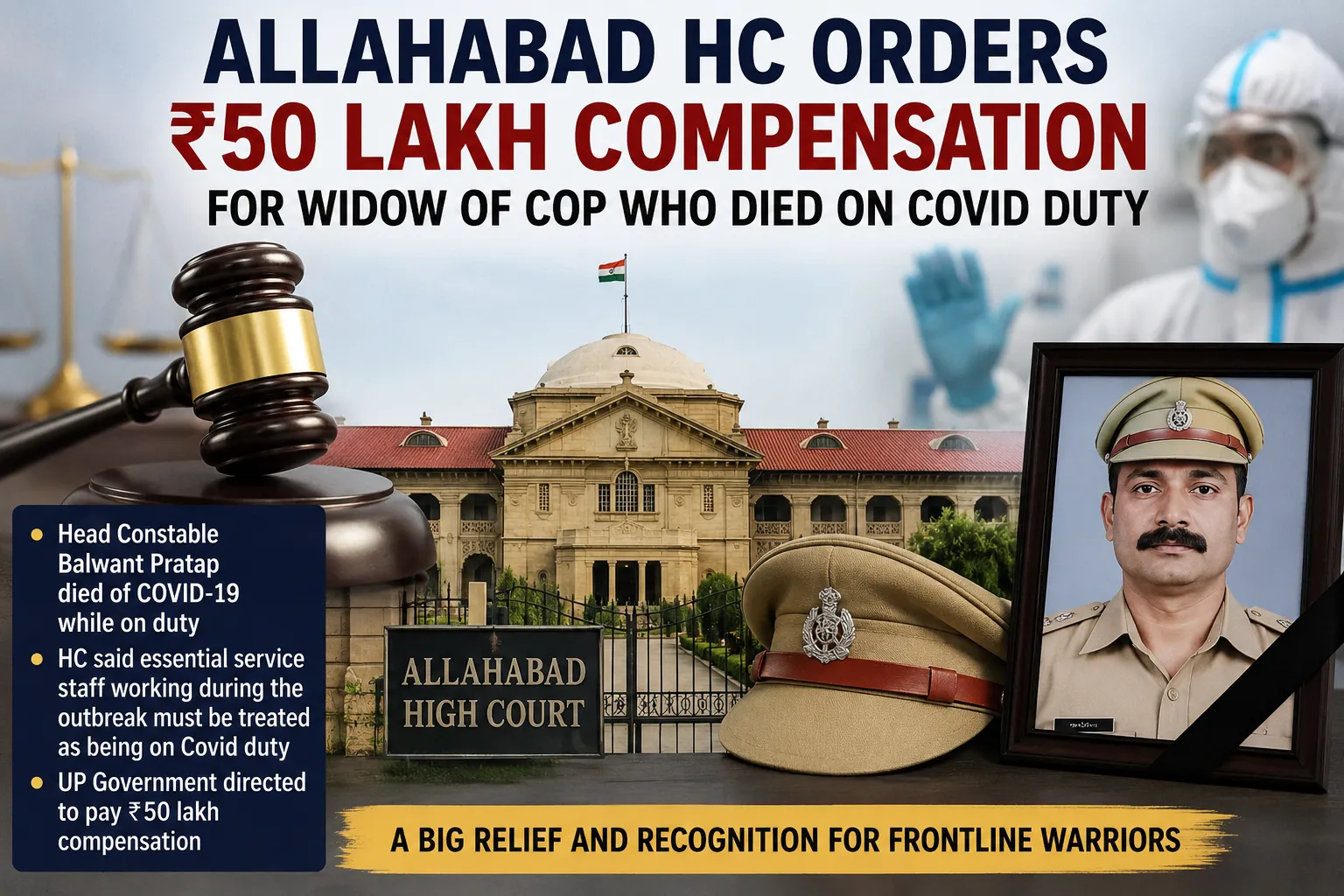
In a significant judgment reinforcing the rights of frontline workers and their families, the Allahabad High Court has directed the Uttar Pradesh government to pay ₹50 lakh as ex gratia compensation to the widow of head constable Balwant Pratap, who died after contracting COVID-19 while performing pandemic-related duties. The court ruled that police personnel and other employees engaged in essential public services during the COVID-19 outbreak should be treated as being on “Covid duty”, even if they were not directly involved in hospital treatment or medical care.
The judgment is being viewed as an important recognition of the sacrifices made by thousands of frontline workers who ensured essential services continued during one of the most challenging public health emergencies in recent history. It also clarifies the interpretation of the Uttar Pradesh government’s COVID compensation policy and strengthens legal protection for families of employees who lost their lives while serving the public.
Background of the Case
The case was filed by Semma Bharti, the widow of late head constable Balwant Pratap. During the COVID-19 pandemic, Balwant Pratap was deployed for duties related to public safety, COVID-19 prevention, public awareness campaigns, and assisting authorities in controlling the spread of the virus. While performing these responsibilities, he contracted COVID-19 and later passed away in April 2021.
Following his death, his widow sought compensation under the Uttar Pradesh Government Order issued on April 11, 2020, which provided ex gratia financial assistance to government employees who died while performing COVID-related duties. However, the state government rejected her application in August 2024, stating that the deceased was not directly engaged in COVID prevention, treatment, or containment work as defined under its interpretation of the policy.
Allahabad High Court Sets Aside Government’s Rejection
The Lucknow Bench of the Allahabad High Court examined the records and concluded that the government’s decision to deny compensation was not supported by the available evidence. The bench observed that official documents issued by the police department and the Chief Medical Officer clearly established that Balwant Pratap had been performing duties connected with COVID-19 management and public safety during the pandemic.
The court therefore quashed the state government’s rejection order dated August 27, 2024, and directed the authorities to release the ₹50 lakh compensation to the widow within eight weeks.
Key observations of the court included:
- The rejection order was inconsistent with available official records.
- COVID-related deployment extended beyond hospital duties.
- Police personnel played an essential role during the pandemic.
- Eligible families should receive benefits under the government policy.
- Compensation should be released within the specified timeframe.
Court Broadens the Meaning of “Covid Duty”
One of the most important aspects of the judgment is the court’s interpretation of the term “Covid duty.” Instead of limiting the definition only to doctors, nurses, and healthcare workers treating patients inside hospitals, the court adopted a broader and more practical interpretation.
According to the court, employees serving in police, electricity, water supply, telephone services, and other essential departments continued working throughout the pandemic to ensure that society functioned despite unprecedented restrictions. Their contribution directly supported public health measures and helped contain the spread of the virus. Therefore, these employees should also be regarded as COVID warriors under the government’s compensation scheme.
Essential service workers recognized by the court include:
- Police personnel.
- Electricity department employees.
- Water supply workers.
- Telephone and communication staff.
- Other government employees maintaining essential services.
Why Police Personnel Were Considered Covid Warriors
The High Court emphasized that police officers were among the most visible frontline workers during the pandemic. Their responsibilities extended far beyond routine law enforcement and included implementing lockdown measures, regulating public movement, assisting health authorities, spreading awareness about safety protocols, and helping infected individuals whenever required.
These duties exposed police personnel to significant health risks because they regularly interacted with the public during periods when COVID-19 transmission remained high. Recognizing these responsibilities, the court observed that denying them the status of COVID warriors would defeat the purpose of the welfare scheme created by the state government.
Major responsibilities performed by police during COVID-19 included:
- Enforcing lockdown restrictions.
- Managing public gatherings.
- Supporting health authorities.
- Assisting COVID-positive individuals.
- Maintaining public order.
- Creating awareness about safety guidelines.
Evidence That Strengthened the Widow’s Claim
The court relied on multiple official records before delivering its verdict. These documents demonstrated that Balwant Pratap had indeed been deployed for pandemic-related responsibilities and that the police department itself had recommended payment of compensation to his family.
Certificates issued by competent authorities established that he had been involved in COVID prevention, awareness campaigns, and assistance activities connected with pandemic management. Based on these records, the court found that the state’s narrow interpretation of the policy was unjustified.
Important evidence considered included:
- Police department deployment records.
- Medical certifications.
- Official duty documents.
- Recommendations supporting compensation.
- Government policy applicable to COVID duty.
Impact of the Judgment on Future Compensation Claims
Legal experts believe this judgment could influence similar compensation claims involving employees who worked in essential services during the COVID-19 pandemic. The decision reinforces the principle that government welfare policies should be interpreted in a manner that fulfills their intended purpose rather than through an overly restrictive reading.
Families whose claims were rejected because their relatives were not directly involved in hospital-based treatment may now have stronger legal grounds to seek reconsideration if official records establish that they performed pandemic-related essential duties. However, each claim will continue to depend on its own facts and evidence.
Possible implications include:
- Wider interpretation of COVID duty.
- Better protection for frontline workers’ families.
- Greater consistency in compensation decisions.
- Recognition of essential public service contributions.
- Encouragement for fair implementation of welfare schemes.
Importance of Government Welfare Policies During Emergencies
The COVID-19 pandemic highlighted the importance of comprehensive welfare measures for frontline workers. Governments introduced various financial assistance schemes to support families of employees who lost their lives while performing essential duties under extremely difficult conditions.
Such policies acknowledge the extraordinary risks accepted by frontline workers and provide financial security to their dependents. Effective implementation of these schemes is crucial to maintaining public trust and recognizing public service during national emergencies.
Objectives of welfare schemes include:
- Supporting affected families financially.
- Recognizing frontline service.
- Providing social security.
- Encouraging public service.
- Ensuring fair policy implementation.
Legal Significance of the Allahabad High Court Decision
The judgment reflects the judiciary’s role in ensuring that government policies are applied fairly and consistently. Courts often examine whether administrative authorities have interpreted welfare schemes in accordance with their purpose and whether deserving beneficiaries have been treated equally.
In this case, the High Court emphasized that essential workers who helped maintain critical public services during the pandemic deserved equal recognition alongside healthcare workers because their work directly supported the state’s efforts to combat COVID-19.
The decision also demonstrates that documentary evidence, departmental recommendations, and official duty records play a crucial role in determining eligibility for compensation under government schemes.
Lessons for Government Departments
The ruling highlights the need for government departments to interpret welfare policies carefully and consistently. Administrative authorities should evaluate claims based on actual duties performed rather than relying solely on narrow technical interpretations.
Departments can improve future implementation by:
- Maintaining accurate duty records.
- Clearly documenting deployment responsibilities.
- Following policy objectives fairly.
- Reviewing evidence comprehensively.
- Ensuring timely processing of compensation claims.
Such measures can reduce unnecessary litigation while providing timely assistance to deserving families.
Conclusion
The Allahabad High Court’s direction to award ₹50 lakh compensation to the widow of head constable Balwant Pratap represents an important affirmation of the contribution made by frontline workers during the COVID-19 pandemic. By recognizing that police personnel and other essential service employees were integral to the state’s pandemic response, the court expanded the practical understanding of what constitutes COVID duty under the Uttar Pradesh government’s welfare policy.
The judgment not only provides long-awaited relief to the bereaved family but also reinforces the broader principle that welfare schemes should be interpreted in a manner that honors the sacrifices of those who served society during extraordinary circumstances. As governments continue reviewing pandemic-related claims, this decision may serve as an important reference point for ensuring that frontline workers and their families receive the recognition and support they deserve.
