
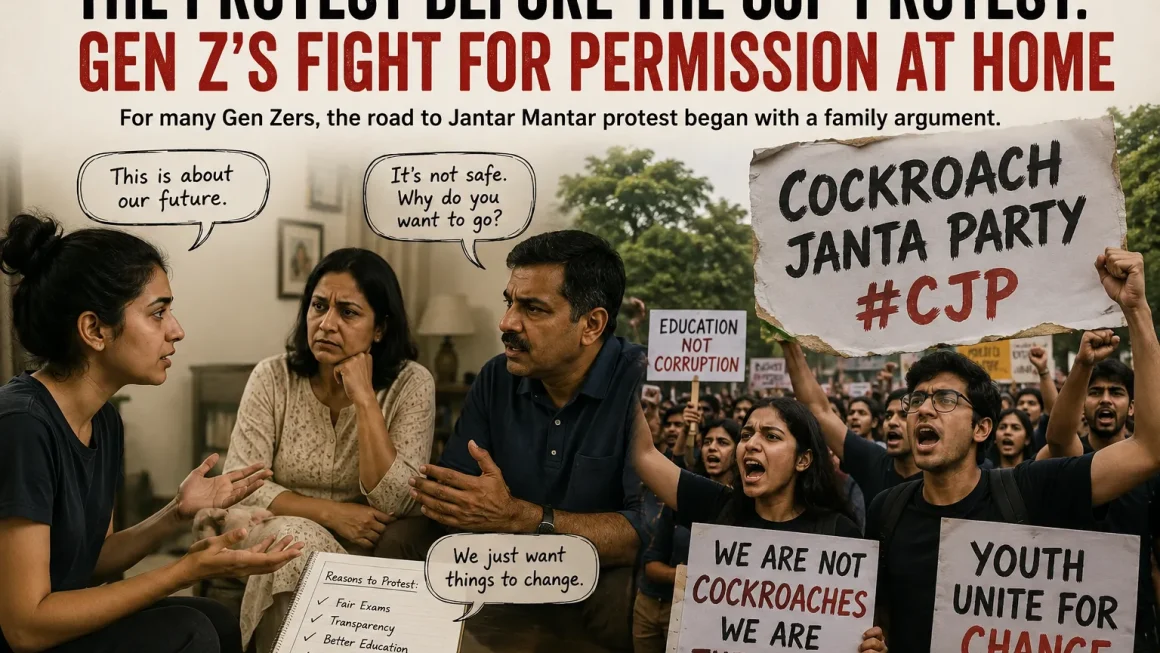
The nationwide demonstrations associated with the Cockroach Janta Party (CJP) movement have highlighted more than public demands for educational reforms and accountability. They have also revealed a deeply personal struggle faced by many young participants—the challenge of convincing their families to allow them to attend a public protest. For numerous members of Generation Z, the first protest did not begin at Delhi’s Jantar Mantar. It began inside their own homes, where discussions with parents often became emotional debates about safety, responsibility, and civic participation.
As thousands of students and young citizens gathered for the CJP demonstrations, many described having to negotiate with worried parents before stepping outside. These conversations reflected broader questions about youth activism, family expectations, and the evolving role of young people in India’s democracy.
Understanding the Background of the CJP Movement
The Cockroach Janta Party began as a youth-driven movement that gained significant attention through social media before expanding into public demonstrations. The movement has focused on issues including examination irregularities, educational reforms, transparency in recruitment systems, and accountability within institutions. What initially started as an online campaign eventually developed into organized protests, with large gatherings taking place at Delhi’s Jantar Mantar and other locations across the country.
The movement attracted students preparing for competitive examinations, recent graduates, young professionals, and citizens concerned about opportunities for education and employment. Its rapid growth reflected widespread frustration among many young Indians regarding issues that directly affect their future.
Why Family Permission Became the First Challenge
For many Gen Z participants, attending the protest was not simply a personal decision. It required convincing parents who worried about safety, legal consequences, and the unpredictable nature of large public gatherings.
Many families viewed participation in protests as potentially risky because demonstrations can sometimes involve crowd control measures, traffic disruptions, or confrontations. Parents often feared their children could unintentionally become caught in difficult situations even if they intended to participate peacefully. These concerns became especially significant after reports of clashes during demonstrations received widespread media coverage.
As a result, numerous young people found themselves explaining why they believed participating was important while reassuring their families that they would remain careful and responsible.
The Difference Between Generations
The discussions within many households reflected a broader generational difference in how civic participation is viewed.
Many parents grew up during periods when protests were less accessible to ordinary citizens or were viewed primarily through the lens of political movements. Their instinct often emphasizes personal safety, educational stability, and avoiding unnecessary risks.
Generation Z, however, has grown up in a digital environment where social media, online campaigns, and public discussions encourage greater awareness of social issues. Many young people see peaceful participation in civic activities as an important way to express opinions and contribute to democratic dialogue.
Neither perspective is necessarily right or wrong. Parents often prioritize protection, while young adults seek greater participation in issues that affect their future.
Social Media’s Role in Mobilizing Young People
Social media played an important role in expanding awareness of the CJP movement. Platforms allowed organizers and participants to share updates, discuss issues, explain protest objectives, and coordinate participation.
For many Gen Z users, these platforms also became spaces where individuals shared personal stories about convincing parents, arranging travel, and preparing to attend demonstrations responsibly.
Digital communication helped many participants feel connected to a larger community that shared similar concerns regarding education, examinations, and employment opportunities.
At the same time, experts continue to emphasize that information shared online should always be verified carefully before being accepted or redistributed.
Safety Remained a Major Concern
One of the primary reasons many parents hesitated to give permission was concern for their children’s safety.
Large public demonstrations can involve heavy crowds, changing security arrangements, transportation challenges, and unexpected developments. Families naturally wanted reassurance that participants would remain safe throughout the event.
Many young protesters reportedly stayed in regular contact with family members during the demonstrations, sharing their location and updates to reduce parental anxiety. This reflects how family support and communication remained important even when opinions initially differed.
Youth Activism Beyond Political Labels
Although the CJP movement has attracted significant political attention, many young participants have described their involvement as being motivated by issues rather than party politics.
For many students, concerns centered on examination systems, transparency, educational opportunities, and future career prospects. These issues directly influence millions of young people preparing for higher education and government recruitment examinations.
The movement illustrates how modern youth activism increasingly focuses on policy outcomes and institutional accountability rather than traditional political identities alone.
The Importance of Peaceful Civic Participation
Peaceful public participation is recognized as an important part of democratic societies. Citizens often use peaceful demonstrations to express concerns, advocate for reforms, and encourage public discussion on important issues.
At the same time, responsible participation includes respecting the law, following official instructions, avoiding violence, and protecting public safety.
For young participants, understanding both their rights and responsibilities is essential. Responsible civic engagement combines informed decision-making with respect for legal processes and public order.
Families Are Learning Together
Interestingly, many conversations between parents and children became opportunities for mutual understanding rather than conflict.
Young people explained why educational reforms mattered to them, while parents shared concerns based on their own life experiences. In many cases, these discussions helped both generations better understand each other’s perspectives.
Rather than creating permanent disagreements, these conversations often strengthened communication within families by encouraging open dialogue about current events, citizenship, and personal responsibility.
What This Means for Generation Z
Generation Z is often described as one of the most digitally connected and socially aware generations. Access to information has made many young people more interested in public policy, education, employment, environmental issues, and governance.
The experiences surrounding the CJP protests demonstrate that youth participation often begins with personal conversations long before individuals join public events.
Learning to communicate respectfully with family members, understand different viewpoints, and make informed decisions represents an important part of responsible citizenship.
Lessons for Parents and Young Adults
The events surrounding the CJP movement offer valuable lessons for both generations.
Parents benefit from listening to the concerns that motivate young people to participate in civic discussions, while young adults benefit from understanding that parental caution usually reflects care rather than opposition.
Open communication, mutual respect, accurate information, and thoughtful decision-making can help bridge generational differences during periods of social change.
When families discuss important public issues calmly and respectfully, they create opportunities for greater trust and stronger relationships.
Conclusion
The story behind the “protest before the protest” highlights an often-overlooked aspect of youth activism. Before reaching Jantar Mantar, many members of Generation Z first had to explain their decisions, answer difficult questions, and earn the trust of their families.
The CJP movement has become more than a public demonstration about educational reforms. It has also revealed how civic participation increasingly begins with conversations inside homes, where young people and parents negotiate questions about responsibility, safety, democracy, and the future.
As India continues to witness greater youth engagement in public life, these family conversations may become just as important as the demonstrations themselves. They remind us that meaningful participation in society starts not only in public spaces but also through respectful dialogue, informed choices, and understanding across generations.
