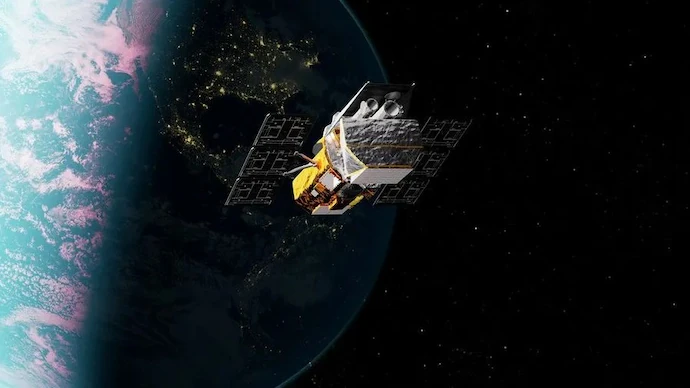
A Rescue Mission Takes A Sudden Turn
NASA’s ambitious attempt to rescue the ageing Neil Gehrels Swift Observatory has officially come to an end after the LINK spacecraft developed serious control problems in orbit. The mission was designed to raise Swift into a safer, higher orbit, but engineers were unable to make LINK reliable enough to complete the planned capture and boost operation. NASA and Katalyst Space Technologies have now abandoned the original rescue plan.
The failure is particularly disappointing because the mission was considered an important demonstration of future satellite servicing technology. LINK was supposed to approach the Swift telescope, inspect its condition, capture it and then use its propulsion system to move the observatory away from its gradually declining orbit. Instead, the rescue spacecraft itself became the main problem that engineers had to fight.
Why NASA Needed To Save Swift
The Neil Gehrels Swift Observatory has been operating since 2004 and became one of NASA’s important tools for studying violent events across the universe. Its instruments have helped scientists observe gamma-ray bursts, which are among the most powerful explosions known to occur in space. Swift has also supported observations of other cosmic objects and short-lived astronomical events.
After more than two decades in orbit, however, Swift began facing a very ordinary but serious problem for satellites in low Earth orbit. Atmospheric drag was gradually pulling the observatory downward. Increased solar activity has also expanded Earth’s upper atmosphere, increasing drag and accelerating the loss of orbital altitude.
Swift originally operated around 600 kilometres above Earth, but its altitude had fallen considerably. Without intervention, the observatory is now expected to re-enter Earth’s atmosphere later in 2026.
LINK Was Built For A Difficult Job
NASA turned to Katalyst Space Technologies for an unusual solution. The company developed LINK, a robotic servicing spacecraft intended to perform a complicated orbital rescue without requiring astronauts.
The spacecraft was launched on July 3, 2026, using a Northrop Grumman Pegasus XL rocket. NASA had awarded Katalyst a $30 million contract, and the company moved remarkably quickly from contract award to launch, completing the spacecraft and mission preparation within roughly nine months.
The basic idea sounded straightforward, although the engineering challenge was anything but simple. LINK needed to navigate toward Swift, match its orbit, inspect the observatory, capture it safely and then provide the necessary boost to move Swift into a higher orbit.
That would have demonstrated a potentially useful capability for future satellites, including expensive spacecraft that might otherwise be lost because of orbital decay.
The Rescue Spacecraft Started Spinning
Problems appeared during LINK’s commissioning phase after launch. NASA reported that the spacecraft experienced attitude-control problems, causing it to spin across multiple axes and creating sporadic communication difficulties.
Two of LINK’s three reaction wheels were also found to be inoperable, while engineers identified additional problems involving its cold-gas thruster system. Reaction wheels are important because they allow spacecraft to control their orientation without constantly firing propulsion systems.
The situation became a race against time.
Engineers managed to reduce LINK’s uncontrolled rotation by using its electric propulsion system. NASA reported on August 6 that the spin had been reduced from roughly nine degrees per second to about 1.47 degrees per second. That looked like a meaningful recovery, and the team began preparing software changes that could potentially allow LINK to operate with its reduced capabilities.
For a while, there was still hope that the mission could continue.
Engineers Tried To Keep The Mission Alive
The rescue effort did not immediately collapse after LINK began spinning. Engineers tested different approaches and worked on software changes that could compensate for damaged or unavailable hardware.
NASA had previously said that teams were considering revised guidance, navigation and control strategies for the spacecraft. The idea was to adapt the mission around the hardware that remained functional instead of simply giving up.
That work showed how difficult spacecraft operations can become after an unexpected failure. Engineers cannot simply replace a damaged reaction wheel when the spacecraft is hundreds of kilometres above Earth. Every solution has to be designed around hardware that already exists, limited fuel, communication delays and changing orbital conditions.
Even after the spin was reduced substantially, LINK still had to perform the most demanding part of the mission. It needed to navigate toward Swift and eventually conduct a controlled rendezvous.
That final step proved too risky.
NASA Finally Cancels The Swift Rescue
NASA and Katalyst Space Technologies have now decided not to attempt the planned capture and orbital boost of Swift. Persistent attitude-control problems meant LINK could not be trusted to safely complete the complicated rendezvous operation.
The cancellation means Swift will not receive the orbital boost that NASA originally hoped would extend its life. Instead, the observatory is expected to continue losing altitude before eventually entering the atmosphere.
NASA’s decision was not simply about whether LINK could reach Swift. A spacecraft rescue requires extremely precise positioning and control, especially when one vehicle must approach and capture another. Attempting the operation with unreliable attitude control could create an even greater risk of losing both spacecraft.
So the safer choice was to stop the original rescue attempt.
LINK May Still Deliver Useful Data
Although the primary objective has failed, the LINK spacecraft itself may not be finished.
NASA and Katalyst plan to use the remaining spacecraft capabilities for rendezvous and proximity operations. These activities can provide useful information about spacecraft navigation, orbital maneuvering and servicing techniques that could support future missions.
That matters because satellite servicing is becoming increasingly important.
Space agencies and private companies are looking at ways to repair, refuel, reposition and remove spacecraft without sending astronauts to every target. A successful system could potentially extend the lives of expensive satellites and reduce the number of abandoned objects left in orbit.
LINK did not complete its biggest objective, but the mission can still offer engineers valuable lessons about designing and operating robotic spacecraft in difficult conditions.
What Happens To Swift Now
For the Swift Observatory, the outlook is much less encouraging.
NASA has already dealt with the observatory’s declining orbit and the effects of stronger solar activity. The telescope’s scientific instruments were shut down earlier in 2026 as part of efforts to preserve the spacecraft while its orbital future was considered.
Without a successful boost, Swift will continue descending.
Eventually, increasing atmospheric drag will cause the observatory to re-enter Earth’s atmosphere. Much of the spacecraft is expected to break apart and burn during that process, bringing an unusually long scientific career to an end.
Swift has operated for more than 20 years, far beyond its original expected mission lifetime. Its loss will therefore be significant for astronomers who have relied on the observatory to rapidly study powerful cosmic explosions and other temporary events.
The Failure Raises Bigger Space Questions
The unsuccessful rescue attempt also highlights how complicated orbital servicing remains.
On Earth, repairing a malfunctioning machine can involve sending technicians, replacing components or changing hardware. In space, a small hardware failure can completely change the mission plan. A spacecraft may still have power and communication while being effectively unable to perform the maneuver it was designed to complete.
The LINK mission also shows why future servicing spacecraft will need considerable redundancy. Multiple independent ways of controlling orientation, communicating with Earth and maneuvering could make the difference between a recoverable failure and a cancelled mission.
That lesson could become even more important as governments and companies attempt more ambitious robotic servicing missions in the coming years.
A Setback But Not A Dead End
The failure of the NASA Swift rescue mission is certainly a setback, but it does not erase the value of the experiment. Swift itself delivered more than two decades of scientific observations, while LINK demonstrated how quickly a private company can develop a spacecraft for an unusual orbital challenge.
The biggest lesson may be that rescuing an ageing satellite is far harder than simply sending another spacecraft into orbit. Matching trajectories, controlling orientation and safely capturing an existing spacecraft require several systems to work perfectly at the same time.
NASA and Katalyst will now have to study what happened and determine which technologies can be improved for future missions. The knowledge gained from LINK could eventually help another spacecraft succeed where this mission could not.
Conclusion: Lessons From A Difficult Space Rescue
NASA’s attempt to save the Swift telescope has ended without the planned orbital boost, after persistent control problems prevented the LINK spacecraft from safely completing its mission. Swift will now continue its gradual descent toward atmospheric re-entry, ending a remarkable scientific career that began in 2004. The failed rescue is disappointing, but it also provides important engineering lessons for future satellite servicing missions. Space technology often advances through difficult experiments as much as successful launches. NASA and its partners can use what LINK taught them to build more reliable rescue and servicing systems for future spacecraft.
Read More :-