
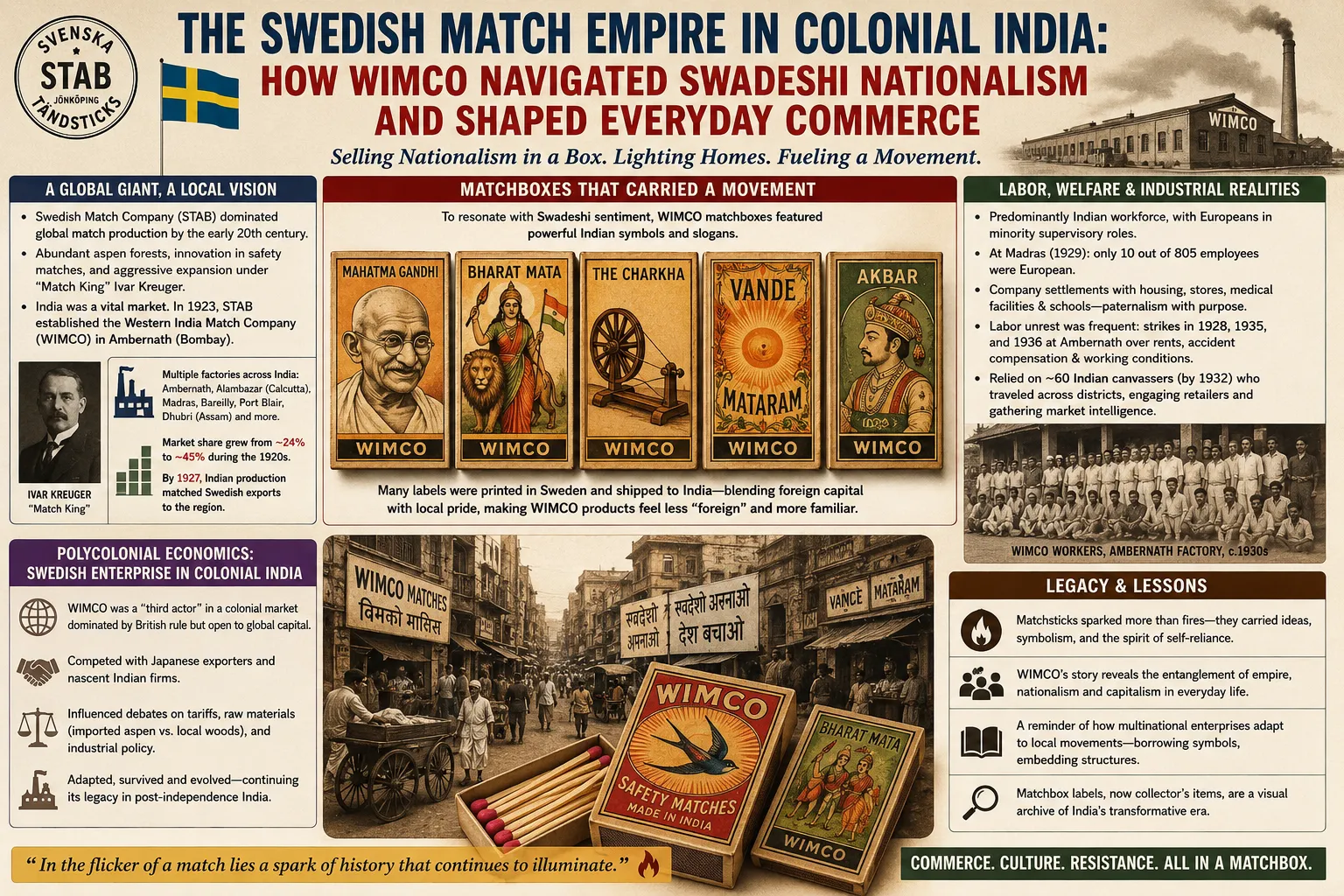
In the bustling markets of colonial India, everyday objects often carried profound political and cultural weight. Among these, matchboxes—humble, ubiquitous items essential for lighting lamps, cooking, and daily rituals—emerged as unexpected canvases for nationalism. A Swedish company, through its Indian venture known as the Western India Match Company (WIMCO), masterfully adapted to the Swadeshi movement by producing and selling matchboxes adorned with images of Mahatma Gandhi, Bharat Mata, the charkha, and slogans like Vande Mataram. This story reveals how non-British foreign actors operated within colonial markets, leveraging local sentiments without direct imperial rule, and highlights the complex interplay of global capital, local labor, and nationalist aspirations.
WIMCO’s history challenges the simplistic binary of British colonizer versus Indian subject, illustrating a “polycolonial” economic landscape where Swedish enterprise thrived amid rising calls for self-reliance.
The Rise of Swedish Match Dominance Globally and in India
Sweden’s match industry, centered in Jönköping, benefited from abundant aspen forests ideal for matchsticks and innovations in safety matches using non-toxic red phosphorus. By the early 20th century, Swedish firms dominated global production, exporting billions of matchsticks annually. The Swedish Match Company (Svenska Tändsticks Aktiebolaget or STAB), led by the ambitious “Match King” Ivar Kreuger, expanded aggressively through acquisitions and cartels, controlling a significant portion of world production by the 1930s.
India represented a vital market. Before World War I, matches were largely imported from Sweden, Japan, and other sources. Domestic Indian production was limited, with few factories hampered by capital shortages, technological gaps, and raw material challenges. Japanese competition intensified during the war, prompting Swedish interests to adapt. In response to tariffs and protectionist pressures, STAB established local manufacturing to secure its foothold.
In 1923, WIMCO was incorporated in Ambernath near Bombay. The company rapidly built a network of factories across India, including sites in Calcutta (Alambazar), Madras, Bareilly, Port Blair, and through the Assam Match Company in Dhubri. By 1927, Indian production matched Swedish exports to the region. WIMCO’s market share grew from about 24% to around 45% during the 1920s, making it a dominant player.
This localization was strategic: it circumvented import duties while tapping into growing domestic demand and employing Indian labor and intermediaries.
Adapting to Swadeshi: Nationalist Imagery on Foreign-Made Matches
The Swadeshi movement, emphasizing self-reliance and boycotts of foreign goods, created both challenges and opportunities. While promoting Indian industries, it also fostered a consumer culture receptive to patriotic symbols. WIMCO capitalized on this by featuring distinctly Indian motifs on its matchboxes. Designs included Mahatma Gandhi, Bharat Mata (Mother India), the spinning charkha symbolizing self-sufficiency, historical figures like Mughal emperors, and evocative slogans such as Vande Mataram.
Many of these visually appealing labels were printed in Sweden and shipped for Indian distribution, blending foreign manufacturing with local appeal. This commercial ingenuity allowed WIMCO to position its products as less “foreign” than overtly British alternatives, navigating the tensions of nationalist consumption. Matchboxes, being inexpensive and widely circulated through bazaars and households, became subtle vehicles for cultural familiarity, even as they represented global capital.
This strategy mirrored broader trends where foreign firms adapted trademarks and designs to suit export markets, turning potential resistance into market advantage.
Labor, Welfare, and Industrial Realities on the Ground
WIMCO’s operations extended beyond commerce to reshape local economies and societies. Factories employed predominantly Indian workers, with Europeans in minority supervisory roles. For instance, at the Madras facility in 1929, only 10 out of 805 employees were European. The company developed worker settlements with housing, company stores, medical facilities, and schools—paternalistic measures that stabilized the workforce while extending corporate influence.
Yet, these were not harmonious idylls. Labor unrest was common, with strikes at Ambernath in 1928, 1935, and 1936 leading to negotiations for better rents, accident compensation, and working conditions. Such conflicts reflected the growing strength of labor politics in late colonial India, where workers bargained against foreign-owned enterprises.
WIMCO relied heavily on Indian canvassers—around 60 by 1932—who traversed districts, engaged retailers, and gathered market intelligence, embedding the company deeply in local commercial networks.
Broader Context: Polycolonial Economics and “Third Actors”
WIMCO exemplifies how “lesser colonizers” or third actors shaped colonial India. While British rule provided the overarching framework, entities like Swedish Match operated through capital investment, technology transfer, and market adaptation without formal political control. This nuanced presence competed with Japanese exporters and nascent Indian firms, influencing tariffs, raw material debates (such as preferences for imported aspen versus local woods), and industrial policy.
The company’s resilience extended post-independence. It navigated import-substituting industrialization, with roots in colonial-era protectionism. Control shifted over time but persisted, with Swedish interests maintaining influence into later decades.
Legacy and Lessons for Understanding Colonial Commerce
The story of WIMCO and its patriotic matchboxes illuminates the entanglement of empire, nationalism, and capitalism in everyday life. Ordinary matchsticks sparked not just fires but conversations about self-rule, economic sovereignty, and global interconnections. They remind us that colonial economies were multifaceted, involving Nordic capital alongside British administration and Indian agency.
In an age of globalization, this history offers insights into how multinational corporations adapt to nationalist movements—borrowing local symbols while embedding foreign structures. It underscores the enduring adaptability of capital, which often outlasts formal empires.
For modern India, reflecting on such episodes enriches understanding of industrial heritage, labor history, and the visual culture of resistance. Matchbox labels, now collector’s items, preserve a visual archive of a transformative era, where a simple Swedish innovation helped light the path through India’s freedom struggle, even as it profited from it.
Conclusion
The Swedish match company’s venture in colonial India, embodied by WIMCO, was far more than a business success. It wove itself into the fabric of Swadeshi India by selling nationalism in a box, employing local talent, and navigating political currents with pragmatism. This forgotten chapter reveals the subtle ways foreign actors influenced markets without ruling them, contributing to a richer, more complex narrative of India’s colonial past and its economic evolution.
As India continues to balance global integration with self-reliance, stories like WIMCO’s serve as powerful reminders of the intricate dynamics between commerce, culture, and sovereignty. In the flicker of a match lies a spark of history that continues to illuminate.
