
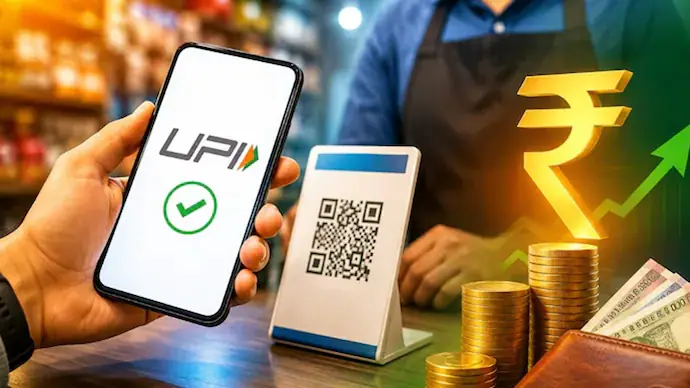
UPI has become such a normal part of daily life that most people rarely think about the cost behind every payment. But recent discussions around UPI charges, Merchant Discount Rate, and the future of digital payments have created fresh confusion among users and shopkeepers. Finance Minister Nirmala Sitharaman has clarified that ordinary UPI users are not being asked to pay a transaction fee, while RBI Governor Sanjay Malhotra has pointed out that maintaining the huge digital payments system does involve real costs.
UPI Charges Create Confusion
For years, people in India have become comfortable scanning a QR code and paying without worrying about additional charges. A small grocery purchase, a restaurant bill, money sent to family, or even a roadside tea can be paid through UPI within seconds. That convenience is now at the centre of a debate about who should ultimately pay for the infrastructure supporting these transactions.
The confusion increased after changes to the legal framework opened the possibility of introducing Merchant Discount Rate, commonly called MDR, on some UPI transactions. Importantly, this does not automatically mean that customers will suddenly see a separate UPI fee deducted from their bank accounts. The government has repeatedly stressed that the proposed framework is mainly concerned with merchant-side charges rather than charging ordinary users directly.
Sitharaman Gives User Clarity
Finance Minister Nirmala Sitharaman has directly addressed the concern about whether people will have to pay for using UPI. Her message has been relatively clear, with the government saying that most UPI transactions will continue without charges for consumers.
Sitharaman also clarified that the recent legislative changes should not be interpreted as an immediate decision to tax every UPI payment made by citizens. According to reports, the relevant amendment creates a legal framework that could allow charges in certain circumstances, but it does not itself introduce a universal fee for every transaction.
That distinction matters because headlines about “UPI charges” can sound much more dramatic than the actual policy discussion. Someone sending ₹500 to a friend should not assume that an extra percentage will suddenly disappear from their bank balance simply because the legal framework has changed.
RBI Governor Raises Bigger Question
RBI Governor Sanjay Malhotra has approached the issue from a slightly different angle, focusing on the economics behind digital payments. He has indicated that running and strengthening payment infrastructure comes with costs, and eventually those costs have to be supported somewhere within the ecosystem.
His comments do not mean that a new UPI fee has already been imposed on customers. Instead, they highlight the longer-term question facing India’s digital payments system. UPI processes an enormous number of transactions every month, while banks, payment companies, technology providers, security systems, and other participants all have expenses connected with keeping the network working.
The RBI’s position therefore adds another layer to the debate. Keeping UPI affordable is important, but making the ecosystem financially sustainable is also becoming increasingly important as transaction volumes continue rising.
What Exactly Is MDR?
MDR stands for Merchant Discount Rate, which is essentially a processing fee associated with digital payments. In a conventional setup, the merchant receiving the payment pays the fee to the relevant financial institutions or payment service providers rather than the customer paying a separate transaction charge.
UPI has largely operated under a zero-MDR model, helping digital payments spread rapidly across India. The government has also provided financial incentives to support the ecosystem. Official government data says approximately ₹8,730 crore was provided through incentive schemes during the four financial years from FY 2021-22 through FY 2024-25.
The new discussion is about whether selected merchant transactions could eventually carry a small MDR. Several models have been discussed, but there is no final universal rate that consumers should currently assume applies to every UPI payment.
Will Normal Users Pay Anything?
For everyday users, the immediate answer is no general UPI fee has been announced. The government’s current clarification is that consumers should not be treated as the direct target of a proposed MDR framework. Person-to-person payments are also expected to remain free under the current direction.
This means sending money from one bank account to another through a normal UPI transfer should not suddenly become equivalent to paying a card processing fee. The same basic expectation applies to many ordinary low-value payments made by consumers.
However, users should understand that “free for the customer” and “free for the entire ecosystem” are two completely different things. Banks and payment companies still have technology, security, fraud-prevention, settlement, and infrastructure expenses even when the person making the payment sees no fee.
Large Merchant Payments Matter
One proposal discussed in the industry involves applying MDR only to selected higher-value merchant transactions. Reuters reported that a leading proposal under consideration involved transactions above ₹2,000 at merchants meeting certain annual turnover conditions, with a possible MDR in the range of 0.3% to 0.5%. These figures are proposals rather than a final nationwide fee structure.
That distinction is extremely important for customers. A proposal discussed by banks, payment companies, or policymakers does not automatically become a rule.
For example, buying a small item from a local shop using UPI should not be treated as proof that every UPI transaction will attract a charge. The final structure, if introduced, could have specific limits, merchant categories, turnover conditions, or transaction thresholds.
UPI Has Become Massive
The scale of India’s UPI ecosystem explains why this debate has become so important. According to the Ministry of Finance, around 55.49 crore users had been onboarded on UPI by June 2026. During FY 2025-26, UPI recorded 24,162 crore transactions with a total value of ₹314 lakh crore.
Those numbers are difficult to ignore. UPI is no longer just another payment option used by technology enthusiasts or urban consumers. It has become part of everyday commerce across cities, towns, small businesses, online platforms, and personal money transfers.
With such a massive network, even a very small fee can create substantial revenue for companies involved in processing payments. At the same time, even a small additional cost could become controversial if businesses try to pass it directly or indirectly to customers.
Why The Government Wants Caution
The government has a strong reason to avoid making UPI expensive for ordinary citizens. Easy digital payments support financial inclusion and reduce dependence on physical cash for countless everyday transactions.
UPI has also become one of India’s most visible digital infrastructure success stories, with millions of consumers depending on it for basic payments. The government’s own data shows how quickly the platform has expanded, including international UPI-linked payment arrangements in several countries.
A sudden fee on every transaction could therefore change user behaviour. People who regularly make tiny payments could become more reluctant to use digital methods, while merchants might also worry about additional operating costs.
The current discussion appears to be trying to avoid that outcome by looking at selected merchant transactions instead of introducing a blanket customer charge.
What Customers Should Watch
For now, UPI users should not panic about paying a new fee every time they scan a QR code. The key issue is not whether UPI suddenly becomes a paid service, but how the payment ecosystem could be funded in the future.
Users should also be careful when merchants claim that a government-mandated UPI fee must be paid immediately. A merchant-side MDR framework, if implemented, would not automatically mean that every customer has to pay an additional percentage on top of the bill.
The final rules will matter far more than social media posts or dramatic headlines. Until the government or relevant authorities announce a specific fee structure, customers should avoid assuming that proposed rates are already mandatory.
The Bigger Digital Payment Debate
The UPI discussion is ultimately about balancing two things that can sometimes pull in opposite directions. Consumers want fast and affordable digital payments, while banks and payment companies need a sustainable business model for maintaining the infrastructure behind those payments.
RBI Governor Sanjay Malhotra’s comments highlight that reality. A payment network operating at India’s current scale cannot be treated as costless infrastructure forever. At the same time, Finance Minister Sitharaman’s clarification shows that affordability for ordinary users remains an important consideration.
So, the debate is unlikely to disappear immediately. What changes next will depend on the final policy decisions, the structure of any MDR, and how banks and payment companies absorb or distribute those costs.
Final Takeaway For UPI Users
For ordinary customers, the biggest takeaway is fairly simple. UPI is not suddenly becoming a paid service for every transaction, despite the recent headlines and discussions around MDR. Finance Minister Nirmala Sitharaman has clarified that consumers will not be the direct target of the proposed merchant-side framework, while RBI Governor Sanjay Malhotra has highlighted the genuine costs involved in maintaining India’s enormous digital payment infrastructure.
The final rules will decide which merchant transactions could eventually attract charges and how those costs are handled. Until then, users should continue using UPI normally while relying on official announcements rather than rumours. For the latest developments on UPI charges, digital payments, and financial policy, keep following credible government and financial news updates.
