
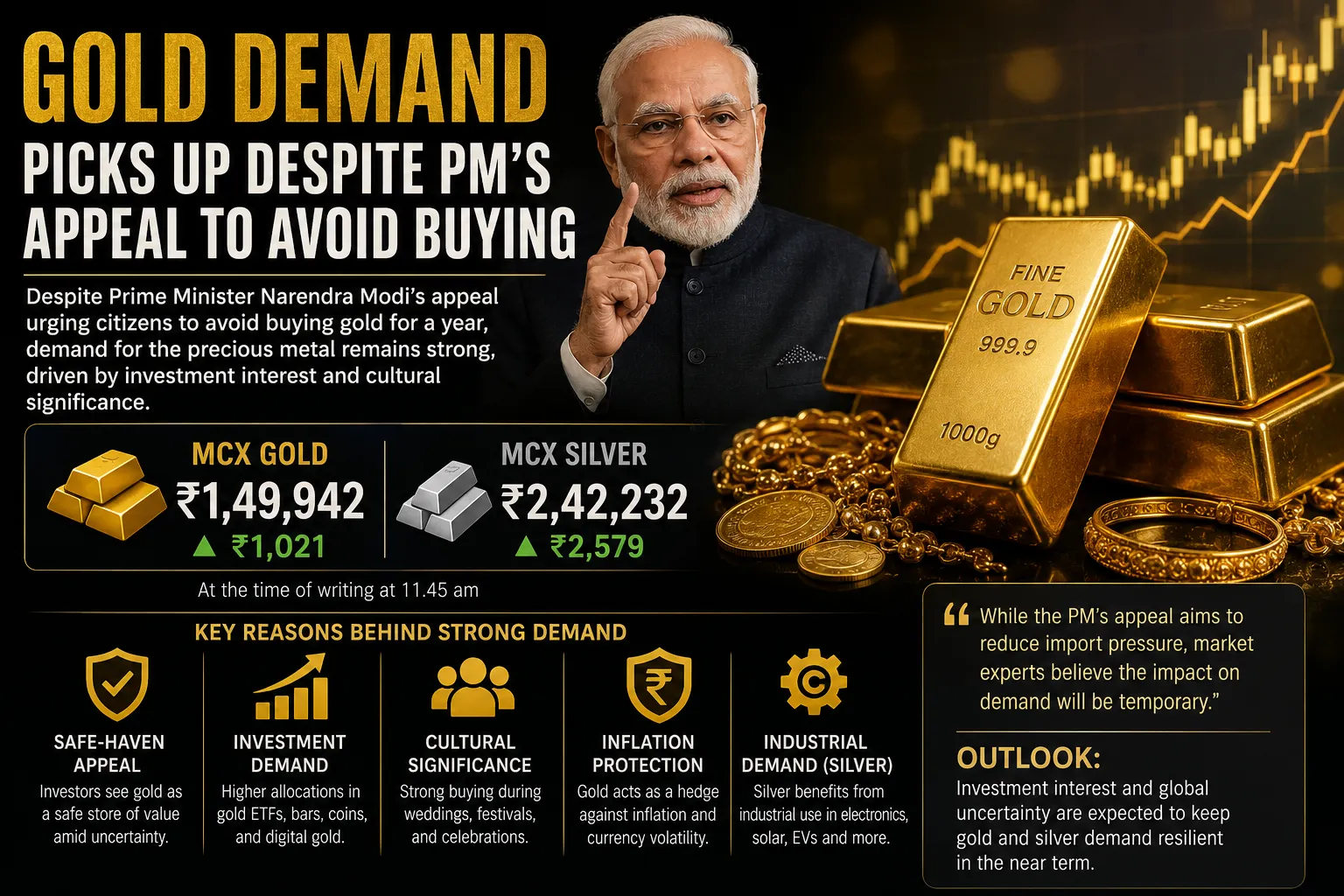
India’s long-standing relationship with gold continues to demonstrate remarkable resilience. Despite Prime Minister Narendra Modi’s recent appeal urging citizens to avoid purchasing gold for a year in an effort to reduce import-related pressure on the economy, demand for the precious metal has shown signs of recovery. Rising prices, strong investment interest, and the cultural significance of gold have helped sustain buying activity across the country.
At the time of writing, Multi Commodity Exchange (MCX) gold was trading at Rs 1,49,942, up Rs 1,021 from the previous session, while silver stood at Rs 2,42,232, higher by Rs 2,579. The gains reflect renewed investor interest in precious metals amid ongoing global economic uncertainty and domestic demand trends.
PM’s Appeal and Its Economic Context
Prime Minister Narendra Modi recently urged Indians to refrain from buying gold for a year, highlighting the impact of large gold imports on India’s foreign exchange reserves and trade balance. Gold imports represent a significant portion of the country’s import bill, and reducing dependence on imported gold could help ease pressure on foreign exchange outflows.
The appeal triggered an immediate reaction in financial markets. Shares of several jewellery companies declined as investors anticipated a potential slowdown in consumer demand. However, industry experts and market participants have largely viewed the appeal as a temporary influence rather than a long-term demand suppressor.
Government officials have also clarified that there are currently no plans to increase import duties on gold and silver, providing reassurance to both consumers and the jewellery industry. This clarification has helped stabilize market sentiment and prevented additional uncertainty regarding precious metal purchases.
Gold Prices Continue to Attract Investors
One of the most notable developments in recent months has been the extraordinary rise in gold prices. According to industry data, domestic gold prices reached record levels during the first quarter of 2026. Despite these elevated prices, investor interest has remained robust.
Historically, higher gold prices often discourage purchases, particularly among price-sensitive consumers. However, the current market environment is different. Many investors view gold as a safe-haven asset capable of preserving wealth during periods of inflation, geopolitical uncertainty, and financial market volatility.
The latest rise in MCX gold prices suggests that investors continue to see value in holding gold as part of their portfolios. Market analysts point to global economic concerns, fluctuating currency values, and uncertainty surrounding international monetary policies as key factors supporting demand.
Investment Demand Leads the Market
Recent trends indicate that investment demand is now playing a larger role in India’s gold market than traditional jewellery consumption.
Data from industry reports show that gold investment demand, including bars, coins, and exchange-traded funds (ETFs), has increased significantly over the past year. Investors have been allocating more capital to gold as a hedge against inflation and economic risks.
This shift is particularly important because it reflects changing consumer behavior. While jewellery purchases remain an important part of Indian culture, more consumers are now viewing gold as a financial asset rather than solely as an ornament or ceremonial purchase.
The growing popularity of gold ETFs and digital gold products has also made investing in the metal more accessible to younger investors who may not wish to purchase physical jewellery.
Jewellery Demand Remains Resilient
Although record-high prices have affected affordability, jewellery demand has not disappeared. Weddings, festivals, and family celebrations continue to drive purchases across the country.
India remains one of the world’s largest gold-consuming nations, and gold jewellery continues to hold deep cultural and emotional significance. For many households, gold is viewed as both a symbol of prosperity and a long-term store of value.
Retailers report that consumers are adapting to higher prices by purchasing lighter-weight jewellery, lower-carat products, and exchanging old gold for new designs. This flexibility has allowed jewellery sales to continue despite the challenging pricing environment.
Industry leaders believe that while demand may experience temporary fluctuations, the fundamental cultural attachment to gold remains intact.
Silver Also Sees Strong Momentum
The rally in precious metals has not been limited to gold. Silver prices have also recorded significant gains, with MCX silver rising by Rs 2,579 to Rs 2,42,232.
Silver benefits from a unique combination of investment demand and industrial usage. The metal plays an important role in sectors such as electronics, renewable energy, electric vehicles, and solar panel manufacturing.
As global demand for clean energy technologies expands, silver consumption is expected to remain strong. This industrial demand provides additional support to prices and differentiates silver from gold, which is primarily driven by investment and jewellery demand.
Investors often turn to silver when they seek exposure to precious metals at a lower entry cost than gold. As a result, silver frequently experiences stronger price volatility during periods of market uncertainty.
Why Gold Demand Remains Strong
Several factors explain why gold demand has continued despite calls for reduced purchases:
1. Cultural Importance
Gold remains deeply embedded in Indian traditions, particularly during weddings, religious festivals, and family celebrations.
2. Safe-Haven Appeal
Investors continue to view gold as a reliable asset during periods of economic uncertainty and market volatility.
3. Inflation Protection
Gold is widely considered a hedge against inflation, making it attractive when consumer prices rise.
4. Portfolio Diversification
Financial advisors often recommend allocating a portion of investment portfolios to gold to reduce overall risk.
5. Rising Investment Awareness
The increasing popularity of gold ETFs, digital gold, and sovereign investment products has expanded access to gold investments.
Outlook for the Precious Metals Market
Looking ahead, market experts expect investment demand to remain a key driver of India’s gold market. Global economic developments, geopolitical tensions, inflation trends, and currency movements will likely continue influencing precious metal prices.
While high prices may limit some discretionary jewellery purchases, investment interest appears strong enough to support overall demand. Industry analysts believe that any slowdown resulting from the Prime Minister’s appeal is likely to be temporary rather than structural.
Silver is also expected to remain in focus due to its growing industrial applications and its role as an alternative precious metal investment.
Conclusion
India’s gold market continues to demonstrate remarkable resilience despite government appeals to reduce purchases and despite historically high prices. The latest gains in MCX gold and silver prices highlight sustained investor confidence in precious metals as stores of value and portfolio diversifiers.
Although policymakers remain concerned about the impact of gold imports on the economy, consumer behavior suggests that demand is unlikely to disappear. Instead, the market is evolving, with investment demand increasingly complementing traditional jewellery purchases.
As economic uncertainty persists and investors seek stability, gold and silver are expected to remain important components of India’s financial and cultural landscape. The coming months will reveal whether rising prices temper demand or whether the enduring appeal of precious metals continues to outweigh economic concerns.
