
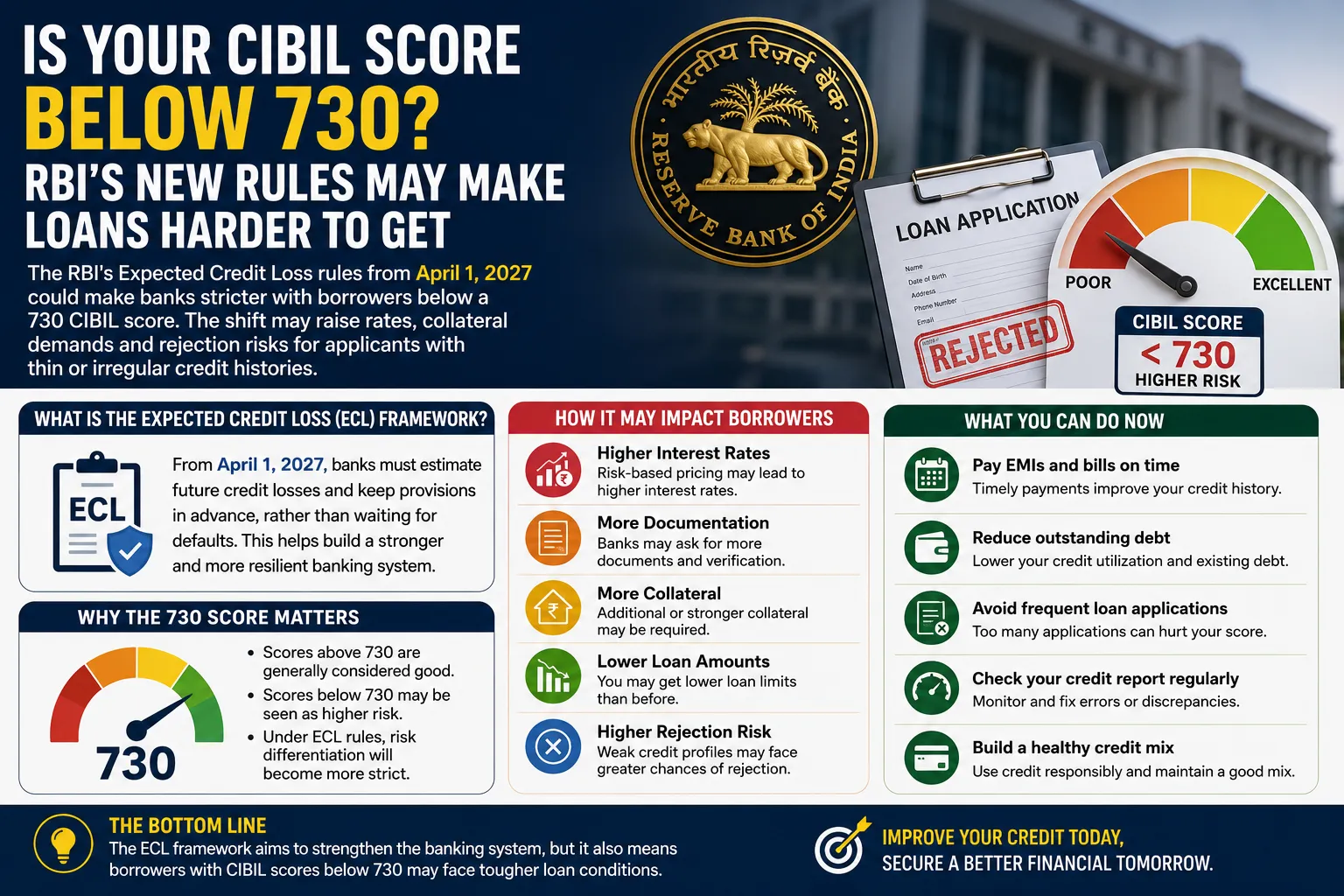
For millions of Indians, a good credit score plays a critical role in accessing affordable loans. Whether applying for a home loan, car loan, education loan, or personal credit facility, lenders use credit scores as an important indicator of a borrower’s repayment capability. Now, a major regulatory change introduced by the Reserve Bank of India (RBI) could significantly influence how banks evaluate loan applications in the future.
Starting April 1, 2027, the RBI’s Expected Credit Loss (ECL) framework will come into effect, changing the way banks assess and prepare for potential loan defaults. While the new rules are primarily aimed at strengthening the banking system and improving financial stability, they may also result in stricter lending standards for borrowers with lower credit scores or limited credit histories.
For individuals with a CIBIL score below 730, the upcoming changes could make obtaining loans more challenging and potentially more expensive.
Understanding the Importance of a CIBIL Score
A CIBIL score is a three-digit numerical representation of an individual’s creditworthiness based on their borrowing and repayment history.
The score generally ranges from 300 to 900. Higher scores indicate stronger credit behavior and lower perceived lending risk. Financial institutions use these scores as one of the primary factors when evaluating loan applications.
Although lending decisions are influenced by multiple factors—including income, employment stability, debt obligations, and repayment capacity—a strong credit score often improves approval chances and helps borrowers secure better interest rates.
In many cases, a score above 750 is considered excellent, while scores between 730 and 750 are generally viewed favorably by lenders. Scores below this range may attract additional scrutiny depending on the type of loan and the lender’s risk appetite.
What Is the Expected Credit Loss Framework?
The Expected Credit Loss framework represents a significant shift in how banks account for lending risks.
Under the traditional approach, lenders typically recognized losses only after clear signs of borrower distress or default appeared. This method focused on incurred losses, meaning financial institutions reacted to problems after they had already emerged.
The ECL framework takes a more proactive approach.
Instead of waiting for defaults to occur, banks will be required to estimate future credit losses based on the probability that borrowers may face repayment difficulties over time. This means lenders must evaluate risks earlier and set aside provisions in advance to cover potential losses.
The objective is to improve the resilience of the banking sector by ensuring that risks are recognized sooner rather than later.
The framework aligns India’s banking practices more closely with internationally accepted accounting and risk management standards.
Why Banks May Become More Selective
Because lenders will have to account for future risks more aggressively, loan underwriting standards may become stricter.
Banks will likely place greater emphasis on factors that help predict future repayment behavior. Credit scores, repayment history, debt-to-income ratios, employment stability, and borrowing patterns could all receive increased attention during the loan evaluation process.
Borrowers who present higher levels of risk may require larger provisions under the ECL model. As a result, lenders could become more cautious when approving applications from individuals with weaker credit profiles.
This does not necessarily mean that loans will be unavailable to such borrowers. However, the approval process may become more rigorous, and loan terms could become less favorable.
Why the 730 Score Threshold Matters
Although the RBI has not officially designated 730 as a mandatory cutoff score, many lending institutions already consider scores around this level as an important benchmark.
Borrowers above this range are generally viewed as lower-risk applicants, while those below it may face closer scrutiny depending on the nature of their credit history.
Under the ECL framework, risk differentiation may become more pronounced.
For example, a borrower with a long history of timely repayments and a credit score above 750 may be perceived as relatively low risk. In contrast, someone with missed payments, high outstanding debt, or a score below 730 may be classified as carrying greater potential risk.
Since banks must estimate future losses, these risk assessments could directly influence lending decisions.
Potential Impact on Loan Applicants
The new framework could affect borrowers in several ways.
Higher Interest Rates
Risk-based pricing may become more common. Borrowers with lower credit scores may face higher interest rates as lenders seek compensation for increased perceived risk.
Additional Documentation
Banks may request more extensive financial information, employment records, income verification, or supporting documentation before approving applications.
Increased Collateral Requirements
Some lenders may require stronger collateral coverage for certain categories of loans, particularly when credit profiles are considered less favorable.
Lower Loan Amounts
Applicants with weaker credit scores may receive lower loan limits than they would have qualified for under previous lending standards.
Greater Rejection Risk
Although every application is assessed individually, borrowers with poor repayment histories may face a higher likelihood of rejection if lenders determine that the risk profile exceeds acceptable thresholds.
Borrowers with Thin Credit Histories Could Also Be Affected
The impact of the ECL framework may not be limited to individuals with low credit scores.
Young professionals, first-time borrowers, and people with limited credit histories may also experience challenges.
When there is insufficient historical data to evaluate repayment behavior, lenders may find it more difficult to assess future risk accurately. As a result, some borrowers with thin credit files could encounter additional scrutiny despite having no history of missed payments.
This highlights the importance of building a strong credit profile early by using credit responsibly and maintaining timely repayments.
How Borrowers Can Prepare Before 2027
The good news is that individuals still have time to strengthen their financial profiles before the new rules take effect.
Pay EMIs and Credit Card Bills on Time
Payment history remains one of the most influential factors affecting credit scores. Consistent, timely payments help establish reliability and improve creditworthiness.
Reduce Outstanding Debt
High debt levels can negatively impact credit assessments. Paying down existing obligations may improve both credit scores and debt-to-income ratios.
Avoid Frequent Loan Applications
Submitting multiple credit applications within a short period can signal financial stress and may affect credit evaluations.
Monitor Credit Reports Regularly
Reviewing credit reports helps identify errors, discrepancies, or unauthorized activity that could impact scores.
Maintain a Healthy Credit Mix
Responsible management of different credit products can contribute positively to a borrower’s overall profile.
Benefits of the New Framework
While borrowers may focus on the possibility of stricter lending standards, the ECL framework also offers broader benefits for the financial system.
By recognizing risks earlier, banks can build stronger financial buffers and improve resilience during economic downturns. Better risk management helps reduce the likelihood of sudden financial shocks and contributes to long-term banking stability.
A healthier banking system ultimately benefits consumers by supporting sustainable lending and reducing systemic vulnerabilities.
In the long run, stronger risk assessment practices may encourage more responsible borrowing and lending behavior across the economy.
Conclusion
The RBI’s Expected Credit Loss framework marks one of the most important changes to India’s banking risk management system in recent years. Scheduled to take effect on April 1, 2027, the framework will require lenders to evaluate future credit risks more proactively and maintain provisions against potential losses.
For borrowers with CIBIL scores below 730, the new environment may bring stricter assessments, higher borrowing costs, additional documentation requirements, and greater scrutiny during the loan approval process. However, individuals who take steps today to improve their credit profiles can position themselves more favorably before the rules come into force.
Ultimately, while the ECL framework may make lending standards more rigorous, it also aims to create a stronger, more resilient financial system that benefits borrowers, banks, and the broader economy over the long term.
