
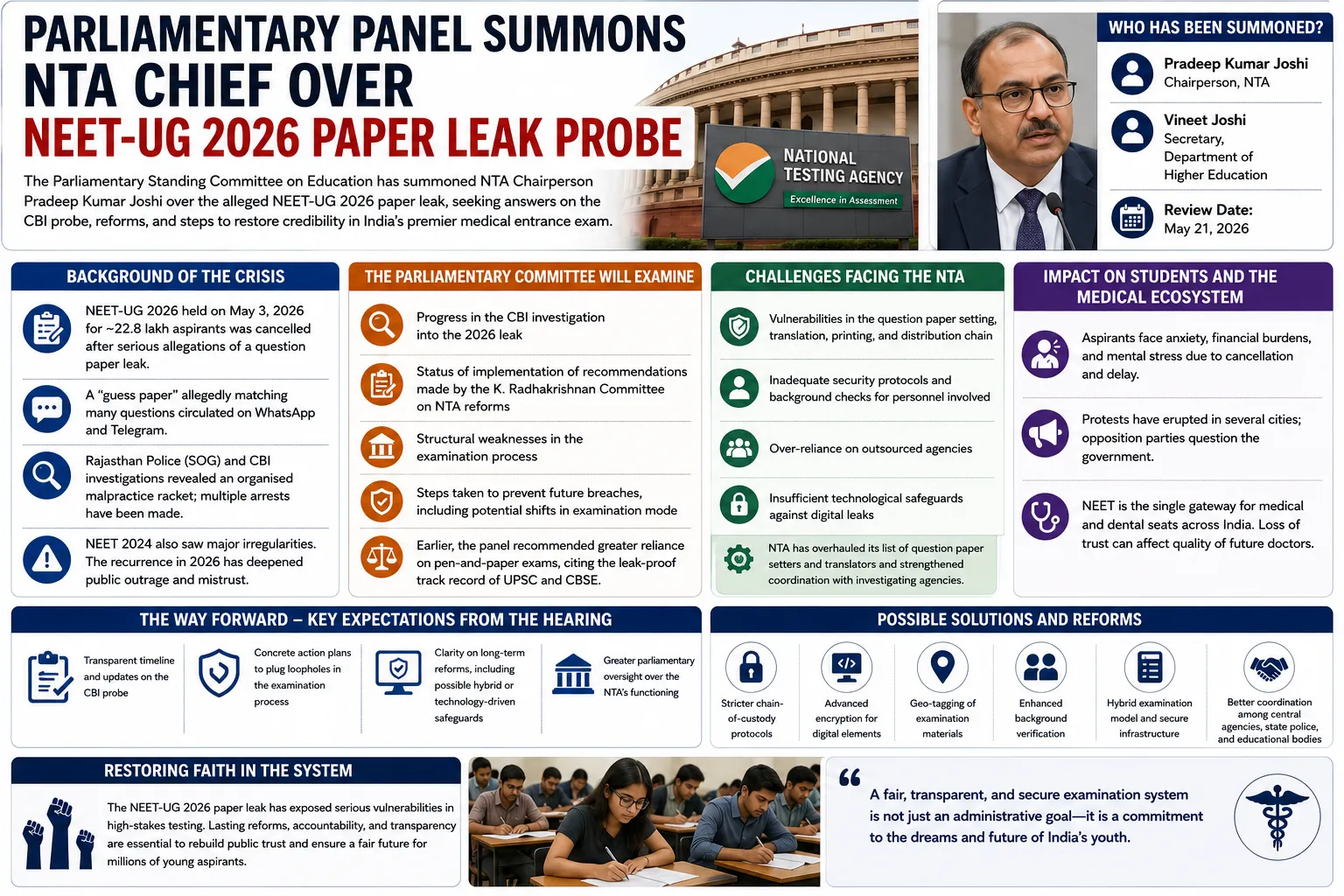
In a significant development amid the ongoing controversy surrounding medical admissions in India, the Parliamentary Standing Committee on Education, Women, Children, Youth and Sports has summoned Pradeep Kumar Joshi, Chairperson of the National Testing Agency (NTA), to appear before it. The panel, chaired by Congress leader Digvijaya Singh, seeks a detailed briefing on the investigation into the alleged NEET-UG 2026 paper leak, the implementation of examination reforms, and measures to restore credibility in the country’s premier medical entrance test.
The NEET-UG 2026 examination, held on May 3, 2026, for approximately 22.8 lakh aspirants, was cancelled following serious allegations of a question paper leak. The NTA took the unprecedented step of scrapping the exam to uphold the integrity of the process, with a re-examination now scheduled for June 21, 2026. The case has been handed over to the Central Bureau of Investigation (CBI), and multiple arrests have been made in connection with the alleged racket.
Background of the Crisis
The controversy erupted shortly after the exam when reports emerged of a “guess paper” circulating on platforms like WhatsApp and Telegram that allegedly matched a significant number of questions in the actual test. Investigations by Rajasthan Police’s Special Operations Group (SOG) and subsequent CBI probes pointed to organised malpractice. The leak is believed to have originated early in the question paper preparation and distribution chain.
This is not the first time NEET has faced credibility issues. The 2024 edition also witnessed major irregularities, leading to widespread protests, court interventions, and demands for systemic overhaul. The recurrence in 2026 has intensified criticism of the NTA’s functioning and raised questions about the effectiveness of reforms introduced after previous scandals.
The Parliamentary Committee’s Role
The summoning of the NTA chief and senior officials, including Vineet Joshi, Secretary of the Department of Higher Education, is part of a broader review scheduled for May 21, 2026. The committee intends to examine:
- Progress in the CBI investigation into the 2026 leak
- Status of implementation of recommendations made by the K. Radhakrishnan Committee on NTA reforms
- Structural weaknesses in the examination process
- Steps taken to prevent future breaches, including potential shifts in examination mode
Interestingly, the same parliamentary panel had earlier recommended greater reliance on pen-and-paper examinations, citing the leak-proof track record of exams conducted by UPSC and CBSE. This suggestion contrasted with the K. Radhakrishnan Committee’s push toward computer-based testing, highlighting ongoing debates on the most secure format for high-stakes national examinations.
Challenges Facing the NTA
The NTA, established in 2017 as an autonomous body to conduct large-scale entrance tests, has come under intense scrutiny. Critics argue that despite its mandate to bring professionalism and transparency, repeated controversies point to deeper systemic issues such as:
- Vulnerabilities in the question paper setting, translation, printing, and distribution chain
- Inadequate security protocols and background checks for personnel involved
- Over-reliance on outsourced agencies
- Insufficient technological safeguards against digital leaks
The agency has responded by overhauling its list of question paper setters and translators and strengthening coordination with investigating agencies. However, demands for making the NTA a statutory body directly accountable to Parliament have gained momentum, with several stakeholders, including doctors’ associations, approaching the Supreme Court on this matter.
Impact on Students and the Medical Ecosystem
The cancellation and subsequent re-examination have caused significant anxiety among aspirants. Many students who had prepared intensively for months now face uncertainty, additional financial burdens, and mental stress. The episode has also triggered protests in several cities, with opposition parties questioning the government’s handling of the education system.
For India’s healthcare sector, the integrity of NEET is crucial. The exam serves as the single gateway for undergraduate medical and dental seats across the country. Any erosion of trust can discourage meritorious students and affect the quality of future doctors.
The Way Forward
The parliamentary panel’s intervention is a timely step toward accountability and reform. Key expectations from the upcoming hearing include:
- A transparent timeline and updates on the CBI probe
- Concrete action plans to plug loopholes in the examination process
- Clarity on long-term reforms, including possible hybrid or technology-driven safeguards
- Greater parliamentary oversight over the NTA’s functioning
Experts suggest that sustainable solutions may involve a combination of measures: stricter chain-of-custody protocols, advanced encryption for digital elements, geo-tagging of materials, enhanced background verification, and possibly a hybrid examination model.
Broader reforms could also include decentralising certain aspects of examination conduct while maintaining centralised standards, increasing investment in secure infrastructure, and fostering greater collaboration between central agencies, state police, and educational bodies.
Restoring Faith in the System
The NEET-UG 2026 paper leak has once again exposed vulnerabilities in India’s high-stakes testing ecosystem. While the NTA and the government have accepted responsibility and initiated corrective actions, the real test lies in implementing lasting reforms that prevent recurrence.
As Pradeep Kumar Joshi and other officials prepare to face the parliamentary committee, the nation watches closely. The outcome of this scrutiny could shape not only the future of NEET but also public confidence in national-level competitive examinations that determine the careers of millions of young Indians.
For aspirants, parents, and educators, the priority remains clear: a fair, transparent, and secure examination process that rewards merit and upholds the sanctity of medical education in the country. The parliamentary review represents an important opportunity to address systemic failures and rebuild trust in one of India’s most critical educational gateways.
Read more –
