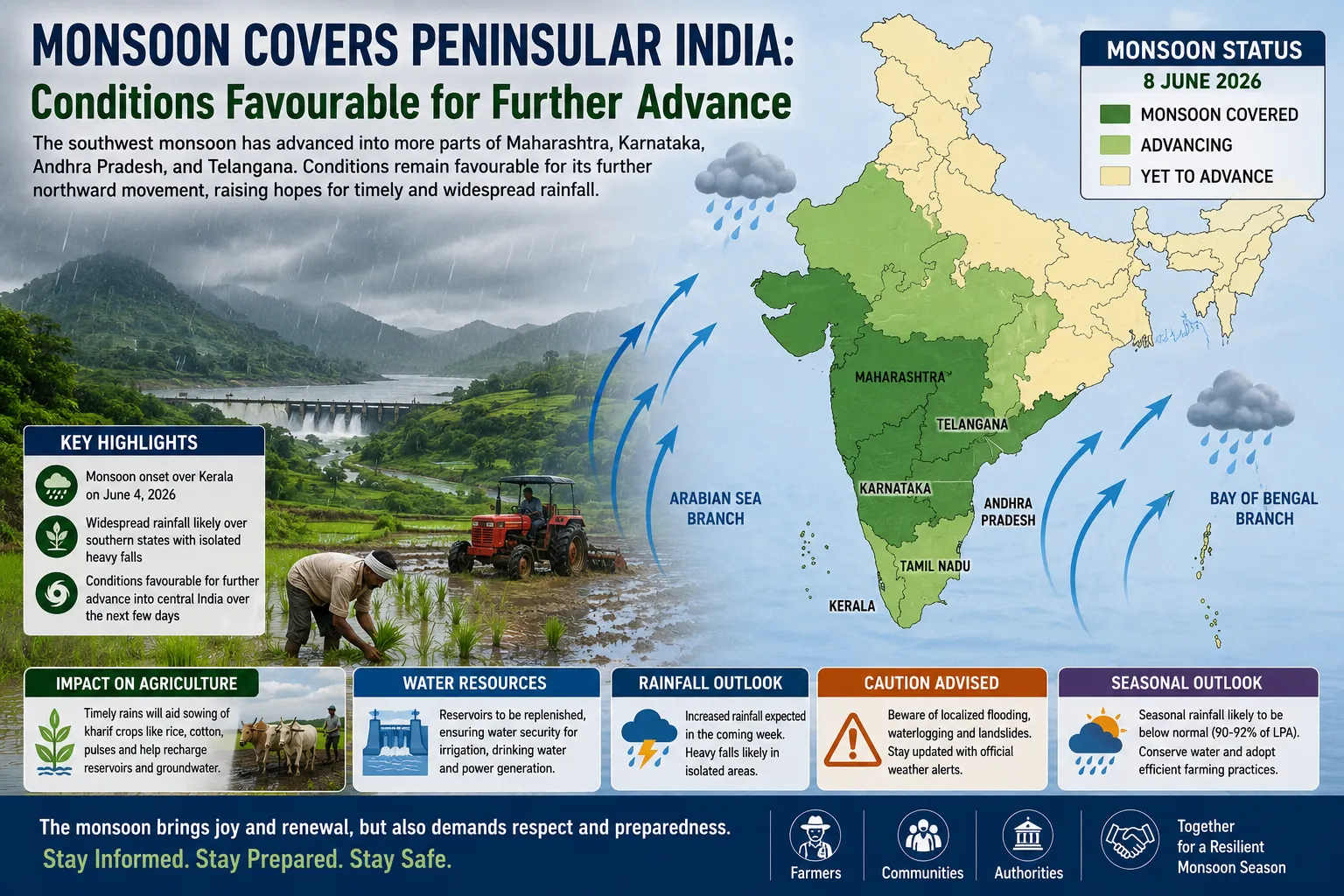
The southwest monsoon, India’s lifeline for agriculture and water security, has made significant progress across peninsular India in early June 2026. According to the India Meteorological Department (IMD), the monsoon has advanced into more parts of Maharashtra, Karnataka, Andhra Pradesh, and Telangana, bringing much-needed relief from the intense summer heat. Conditions remain favourable for its further northward movement, raising hopes for timely and widespread rainfall across the country in the coming weeks.
This year’s monsoon onset over Kerala occurred on June 4, slightly later than the normal date of June 1. However, the subsequent progress has been encouraging, with the system gaining momentum over the Arabian Sea and Bay of Bengal branches. The timely coverage of key peninsular states is particularly significant for rain-fed agriculture, reservoir replenishment, and overall economic activity in southern and western India.
Current Status of Monsoon Advance
As of June 8, 2026, the southwest monsoon has covered substantial portions of the west-central and east-central Arabian Sea, along with key regions in Maharashtra (including parts of Konkan, Madhya Maharashtra, and Marathwada), Karnataka, Andhra Pradesh, and some areas of Telangana. This advancement follows the monsoon’s entry into Kerala, Lakshadweep, and parts of Tamil Nadu and Karnataka in the preceding days.
The IMD has noted that widespread to fairly widespread rainfall activity, accompanied by thunderstorms and lightning, is likely over southern states in the coming days. Heavy rainfall is expected in isolated pockets, particularly along the Western Ghats and coastal regions. These developments are critical as peninsular India relies heavily on the early arrival and steady progress of the monsoon for sowing kharif crops such as rice, cotton, and pulses.
Factors Supporting Further Progress
Meteorological conditions currently favour the monsoon’s continued advance. Favourable wind patterns, adequate moisture incursion from the Arabian Sea, and the development of low-pressure systems are supporting the system’s northward push. The IMD has indicated that conditions are likely to remain conducive for the monsoon to cover remaining parts of Maharashtra, entire Karnataka and Tamil Nadu, additional areas of Telangana and Andhra Pradesh, and parts of central India over the next few days to a week.
Sea surface temperatures in the Indian Ocean remain supportive, although evolving climate patterns such as a potential weak El Niño are being closely monitored for their possible influence on the seasonal rainfall distribution. Despite an overall seasonal forecast leaning towards below-normal rainfall for the country (around 90-92% of the Long Period Average), the initial progress in southern and western regions offers a positive start to the season.
Impact on Agriculture and Water Resources
The early coverage of peninsular states is a welcome development for farmers. Maharashtra, Karnataka, Andhra Pradesh, and Telangana are major contributors to India’s agricultural output. Timely rains will facilitate the sowing of kharif crops and help recharge reservoirs, many of which were below normal levels after a hot pre-monsoon period.
In Maharashtra, the advance into Konkan and other regions will benefit horticulture and paddy fields. In Karnataka, the Western Ghats are already witnessing good rainfall, which is crucial for coffee, tea, and spice plantations. Coastal Andhra Pradesh and Telangana stand to gain from improved soil moisture conditions ahead of the main sowing season.
Rainfall Outlook and Precautions
The IMD has forecast increased rainfall activity across peninsular and central India in the coming week. While this brings relief from heatwaves, it also necessitates caution. Heavy rainfall warnings have been issued for isolated areas, with the potential for localized flooding, waterlogging in urban centers, and landslides in hilly terrains.
Residents in vulnerable areas are advised to stay updated with official weather bulletins, avoid low-lying areas during heavy downpours, and ensure proper drainage systems are functional. Farmers should time their sowing activities according to local forecasts to maximize benefits while minimizing risks.
Broader Seasonal Context
Although the initial advance is promising, the overall 2026 southwest monsoon season is projected to deliver below-normal rainfall for the country as a whole. This underscores the importance of water conservation, efficient irrigation practices, and crop planning aligned with expected rainfall patterns. The government and state administrations are expected to activate contingency plans, including cloud seeding in select areas if needed, and promote drought-resistant crop varieties.
The monsoon’s performance remains critical for India’s economy, as it directly influences agricultural production, rural incomes, inflation (particularly food prices), and GDP growth. A well-distributed monsoon can offset some of the challenges posed by the overall below-normal forecast.
Looking Ahead
With conditions favourable for further advance, the coming days will be crucial in determining the monsoon’s trajectory into central and northern India. The IMD will continue to monitor key parameters such as the position of the monsoon trough, cross-equatorial flow, and Madden-Julian Oscillation (MJO) activity.
For citizens across the country, this is a time for cautious optimism. While the monsoon brings joy and renewal, it also demands respect and preparedness. Farmers, urban planners, disaster management authorities, and common citizens all have roles to play in maximizing the benefits and minimizing the risks associated with this vital weather system.
As the southwest monsoon marches forward across peninsular India, it carries with it the promise of a productive season ahead — provided we approach it with the right mix of anticipation, caution, and preparedness.