
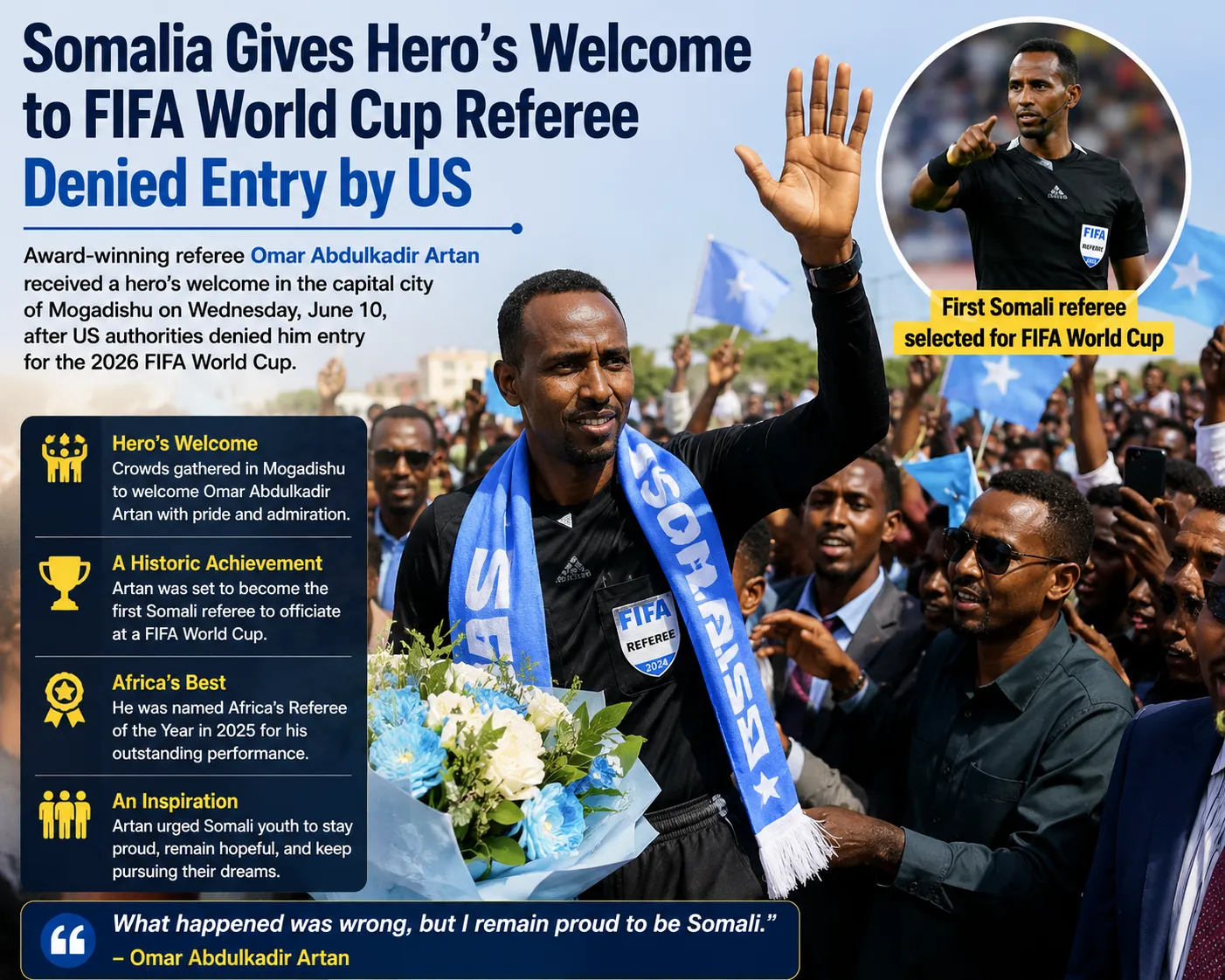
Sport has long served as a powerful symbol of hope, achievement, and national pride. For many countries, seeing their athletes, coaches, and officials succeed on the international stage represents far more than personal accomplishment—it reflects the progress and aspirations of an entire nation. In Somalia, that sentiment was on full display when award-winning referee Omar Abdulkadir Artan returned home to a hero’s welcome after being denied entry into the United States ahead of the 2026 FIFA World Cup.
Although Artan’s dream of officiating at football’s biggest tournament was unexpectedly cut short, the reception he received in Mogadishu demonstrated the immense respect and admiration he has earned throughout his career. For many Somalis, his achievements remain a source of inspiration regardless of the circumstances that prevented his participation in the tournament.
A Historic Opportunity Interrupted
Omar Abdulkadir Artan had been preparing for one of the most significant moments of his professional career.
Selected among the officials for the 2026 FIFA World Cup, Artan was set to make history as the first Somali referee to officiate at the global tournament. His appointment represented a remarkable achievement not only for him personally but also for Somali football, which has worked for years to strengthen its presence on the international stage.
The FIFA World Cup is widely regarded as the pinnacle of international football. Referees selected for the competition undergo rigorous evaluations, fitness testing, and years of professional development before earning a place among the tournament’s elite officials.
For Artan, the appointment was recognition of years of dedication, discipline, and consistent excellence in refereeing.
However, shortly before the tournament began, he was denied entry into the United States, one of the host nations of the 2026 World Cup. The decision meant that he would not be able to participate in the event despite having been selected by FIFA.
The development generated significant attention within the football community and sparked widespread discussion across Somalia and beyond.
A Hero’s Welcome in Mogadishu
Despite the disappointment surrounding the situation, Artan’s return to Somalia became a moment of celebration.
When he arrived in Mogadishu, supporters, officials, and members of the sporting community gathered to welcome him home. Videos and photographs from the event showed crowds greeting the referee with enthusiasm and appreciation.
The reception reflected the deep sense of pride many Somalis feel toward Artan’s accomplishments.
Rather than focusing solely on the setback, supporters emphasized the historic nature of his achievement. Becoming the first Somali referee selected for a World Cup remains a milestone that few thought possible only a generation ago.
For many observers, the welcome served as a reminder that success is not defined only by participation in an event but also by the journey that leads there.
Artan’s achievements have already secured his place in Somali sporting history.
From Local Matches to International Recognition
Artan’s rise through the world of football officiating has been a story of perseverance and professional excellence.
Beginning his career in Somali football, he steadily built a reputation for fairness, consistency, and strong decision-making. Over time, his performances earned opportunities at increasingly prestigious competitions.
His work at regional and continental tournaments attracted attention from football administrators and international governing bodies. As his experience grew, so did his reputation as one of Africa’s most respected referees.
A major breakthrough came when he was recognized as Africa’s Referee of the Year in 2025, one of the highest honors available to match officials on the continent.
The award reflected years of hard work and positioned him among the elite referees eligible for major international tournaments.
His subsequent selection for the World Cup appeared to be the natural next step in an already impressive career.
Why His Story Resonates in Somalia
For Somalia, Artan’s success carries significance beyond football.
The country has faced numerous challenges over recent decades, including political instability, security concerns, and economic difficulties. Against that backdrop, stories of international achievement often hold special meaning.
Successful athletes, officials, and professionals provide positive examples for younger generations and demonstrate that global recognition remains possible despite obstacles.
Artan has become one of those role models.
Many Somali youths view his journey as evidence that dedication and professionalism can create opportunities on the world stage. His achievements have helped shine a spotlight on Somali talent and the growing development of sports within the country.
The public response to his return reflects how strongly people identify with that message.
The Role of Referees in Modern Football
While players and coaches often receive the majority of attention, referees play a critical role in the success of professional football.
At the highest levels of competition, officials are responsible for maintaining fairness, enforcing rules, and managing some of the most intense moments in sport. Their decisions can influence the outcome of matches watched by millions of fans worldwide.
Becoming a World Cup referee requires years of preparation, physical conditioning, and technical expertise.
Officials must demonstrate exceptional knowledge of the game while maintaining composure under immense pressure. Every decision is scrutinized by players, coaches, broadcasters, and supporters.
Selection for the World Cup is therefore considered one of the highest honors in football officiating.
Artan’s appointment reflected international confidence in his abilities and professional standards.
A Symbol of Resilience
One of the most notable aspects of the story has been Artan’s response to the situation.
Rather than expressing bitterness, he has focused on gratitude, resilience, and future opportunities. Reports indicate that he encouraged Somali youth not to lose hope and emphasized the importance of remaining proud of their country.
His reaction has reinforced the qualities that made him respected within football circles in the first place.
Leadership in sport is often demonstrated not only during moments of success but also during moments of adversity. By maintaining a positive outlook, Artan transformed a personal disappointment into an opportunity to inspire others.
Such resilience has become a central theme of his story.
What This Means for Somali Football
Although Artan will not participate in the 2026 World Cup, his achievement may still have a lasting impact on Somali football.
His success has increased international visibility for Somali referees and highlighted the progress being made within the country’s football ecosystem. Young officials now have a tangible example of what can be achieved through commitment and professionalism.
His journey may encourage greater investment in referee development programs, coaching education, and football infrastructure.
In many ways, pioneers create opportunities for those who follow.
Artan’s historic selection has already expanded perceptions of what is possible for future generations of Somali sports professionals.
Looking Ahead
The hero’s welcome given to Omar Abdulkadir Artan illustrates how sporting achievements can unite communities and inspire nations. Although circumstances prevented him from officiating at the 2026 FIFA World Cup, his accomplishments remain a source of immense pride for Somalia.
His story is ultimately about more than a single tournament. It is about perseverance, excellence, and the power of representation. By reaching the highest levels of international football officiating, Artan has shown that talent and determination can overcome significant challenges.
For Somalia, his legacy extends far beyond the football field. He has become a symbol of national pride, resilience, and possibility—an example that future generations can look to as they pursue their own dreams on the global stage.
