
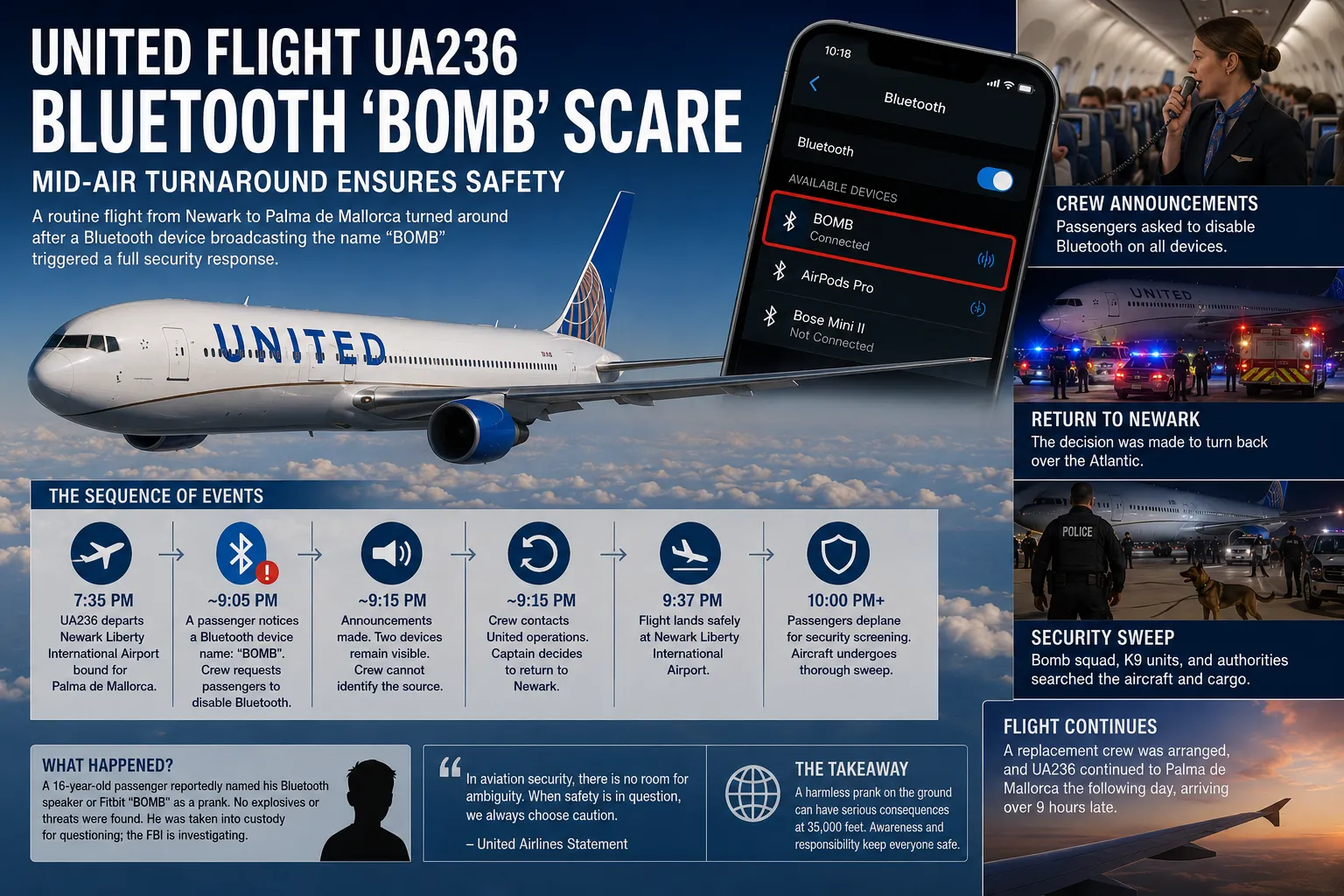
In an era where air travel balances convenience with stringent security measures, even the smallest anomaly can prompt decisive action. On May 30, 2026, United Airlines Flight UA236, en route from Newark Liberty International Airport to Palma de Mallorca, Spain, became a notable case study in this reality. What began as a routine international departure escalated into a mid-Atlantic turnaround after a passenger’s Bluetooth device broadcast a name that raised immediate red flags: “BOMB.”
The Boeing 767 carried approximately 190 passengers and 12 crew members when the incident unfolded roughly 90 minutes after takeoff. According to accounts from those onboard, a fellow traveler first noticed the suspicious Bluetooth network name during the initial phase of the flight. Despite announcements instructing passengers to disable Bluetooth connections on their devices, the signal persisted. Crew members made repeated requests, noting that two devices remained discoverable, but the source could not be immediately identified.
Faced with an unresolved potential security concern, the flight crew escalated the matter to United Airlines’ operations center. Following established protocols for any threat involving explosive references, the captain decided to turn the aircraft back toward Newark. The plane landed safely later that evening around 9:37 PM. No injuries or actual threats materialized, but the event disrupted travel plans for everyone aboard and highlighted the zero-tolerance approach modern aviation takes toward any hint of danger.
The Sequence of Events
Passengers described a tense but orderly process. Jordan Moore, one traveler on the flight, shared her experience on social media, detailing how the discovery occurred shortly after departure. Crew announcements grew more urgent, emphasizing that the flight could not proceed until the issue was resolved. Air traffic control communications later referenced a “certain four-letter word” in a device name, which multiple reports confirmed as “BOMB.”
Upon landing at Newark, authorities wasted no time. Passengers were asked to deboard while law enforcement, including Port Authority police, bomb squad units, and K9 teams, conducted a thorough sweep of the aircraft, cabin, and cargo areas. Travelers underwent additional security screening by the Transportation Security Administration (TSA) and other agencies before being permitted to reboard. The process caused significant delays, but it ensured absolute safety.
Investigators eventually traced the device to a 16-year-old passenger who had named his Bluetooth speaker—or possibly a Fitbit—the provocative term. Reports suggest it may have been a longstanding prank or casual rename rather than a deliberate attempt to disrupt the flight. The teen was reportedly taken into custody for questioning, and the FBI launched an investigation. United Airlines arranged for a replacement crew, and the flight eventually continued to its destination the following day, though passengers arrived over nine hours late.
Why Such a Strong Response?
Aviation security operates under post-9/11 frameworks that prioritize prevention over risk assessment in ambiguous situations. Any reference to “bomb” or similar terms in communications, luggage, or digital signals triggers immediate protocols. Bluetooth devices, while convenient for connecting headphones, speakers, and wearables, can broadcast names visible to nearby gadgets within range. This visibility, combined with the high-stakes environment of a transatlantic flight, left little room for interpretation.
Airlines train crews to err on the side of caution. In this case, the inability to quickly locate and disable the device forced a difficult but necessary decision. Turning back over the Atlantic minimized variables compared to continuing onward or diverting to an alternate airport. This incident underscores how technology intersects with security: what seems like a harmless joke on the ground can have outsized consequences at 35,000 feet.
Broader Implications for Air Travelers
This event serves as a timely reminder for passengers about responsible device usage. Bluetooth should generally remain disabled during flights unless actively needed, both to conserve battery and to avoid unnecessary complications. Renaming devices with provocative or humorous terms may seem innocuous at home but can create chaos in sensitive settings like airports or airplanes.
For airlines and regulators, the episode highlights ongoing challenges in managing consumer technology aboard aircraft. While Bluetooth itself poses minimal technical risk to avionics—modern planes are shielded against interference—its social and perceptual implications demand attention. Enhanced crew guidance on handling digital signals and clearer passenger briefings could reduce similar occurrences.
From a passenger perspective, the inconvenience was substantial: hours of waiting, repeated screenings, and delayed arrivals. Yet, the professional handling by the crew and ground teams prevented escalation and restored confidence. United Airlines confirmed the return was due to a “potential security concern,” maintaining transparency without compromising investigative details.
Lessons in Vigilance and Proportionality
Incidents like this reveal the human element in aviation security. Passengers who reported the suspicious name demonstrated good situational awareness. Meanwhile, the crew’s calm communication helped manage anxiety onboard. No credible threat was found, affirming that the system’s design works as intended—detecting anomalies and responding decisively.
However, it also sparks discussion about proportionality. Critics may question whether a full turnaround was necessary once the device owner was potentially identifiable, but experts emphasize that verifying zero risk takes precedence. In high-altitude operations far from land, conservative decisions protect lives.
Travelers can take proactive steps to avoid contributing to such scenarios. Review device names before travel, disable unnecessary wireless features during flights, and report concerns promptly but calmly to crew. Parents should also guide younger travelers on appropriate technology use in public and confined spaces.
The Future of Aviation Security in a Connected World
As wearable tech, smart luggage, and personal networks proliferate, aviation authorities continue refining protocols. The International Air Transport Association (IATA) and bodies like the FAA monitor emerging risks from consumer electronics. This case may prompt reviews of Bluetooth visibility during security briefings or cabin announcements.
Ultimately, Flight UA236’s diversion reminds us that safety remains paramount. The swift resolution—no harm to passengers, aircraft cleared, and journey completed—demonstrates the robustness of current systems. While the cause proved benign, the response prevented any possibility of oversight.
In our increasingly digital lives, awareness bridges the gap between innovation and security. A simple device name turned an ordinary flight into an international story, reinforcing that in aviation, vigilance is everyone’s responsibility. Passengers, crews, and authorities working together ensure the skies remain safe for millions of travelers daily.
